Generate summary with AI

Syncro has been a trusted IT management solution for years, but many IT teams and MSPs are seeking alternative solutions due to the platform’s limitations.
You may already be a Syncro user or considering becoming one and want to learn more about alternatives. In the end, not all IT management solutions are created equal, so conducting research is important.
To assist you, we’ve done the research and compiled a list of the top 11 Syncro alternatives on the market, according to our own research and by speaking to users.
The best Syncro alternatives are:
The 11 best Syncro alternatives for IT teams and MSPs in 2026
Let’s look at the top Syncro alternatives for IT teams and MSPs based on our research and customer reviews of each platform.
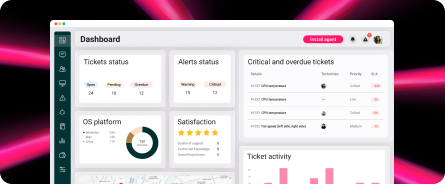
1. Atera

Atera vs. Syncro: Key differences
1. Key features: Atera and Syncro both compete in the all-in-one IT management space with RMM software, PSA, ticketing, remote access, and patch management features. While Syncro is used mainly by small MSPs and IT teams, Atera’s features suit both larger enterprises and SMEs.
2. Agentic AI: Atera is G2’s best AIOps tool, thanks to our innovative Agentic AI technology (Atera’s AI agents).
Atera’s Robin is designed to handle IT requests and routine tasks autonomously, so your IT team can shift from support to priority projects that move the needle.
As of July 2025, Syncro has introduced AI features within its platform, but it’s mainly focused on responding to tickets and generating scripts. Atera’s AI agents can do the same, but also expand to other areas of IT.
3. Pricing: Both Atera and Syncro use pay-per-technician pricing, which is different from most RMM pricing solutions. Atera is transparent on pricing, with no extra “hidden fees” once you sign up for the platform.
Capabilities and features
Both Atera and Syncro are highly rated for ease of use; however, Atera is the only one given an award by G2 for both its ease of use and setup.
Based on G2 comparison, Atera beats out Syncro in literally every category:

To see the detailed comparison of these two solutions, check out the full analysis here.
Another added benefit of Atera is our AI agents, which we already discussed a bit.
Not only is there Robin for empowering end-users, but Atera’s AI Copilot for technicians. Whether you’re generating scripts, summarizing tickets, troubleshooting devices, or creating documentation, Copilot is there to assist in real-time.
Aside from our cloud offerings, Atera users get access to a mobile app that is perfect for IT departments and MSPs who want to manage tickets and other tasks from their smartphones.
Available customer support
Although we offer an intuitive interface and easy onboarding process, you may still need help at times. For this reason, Atera offers 24/7 live agent support in multiple languages.
Syncro has email and phone support available, but it’s not 24/7, and users have reported slow response times.
For self-directed help services, both Atera and Syncro offer resources for their IT communities. They enable users to interact with other users and resources to make the most of the platforms.
One of the resources for Atera is the available Help Center.
We’ve also doubled down on our commitment to accessible IT learning and education with our exciting new IT game, dubbed “Apollo IT.” This game takes place in an intergalactic setting where you, an IT expert, need to help a team of space explorers resolve some IT challenges on their ship. You will interact with our specially programmed AI bot to hone your IT problem-solving skills and work on troubleshooting the IT issues that arise during this journey.
Customer reviews and ratings
Atera’s G2 Rating: 4.6 out of 5 stars (830+ reviews)
What Atera users are saying on G2:
- “Atera’s shared dashboard makes it easy to track performance and spot any security issues in real-time,” a G2 user says.
- “As a project manager, I find Atera’s reporting dashboard super useful. It lets me keep an eye on our data servers in real time,” a G2 user says.
Atera’s Capterra Rating: 4.6 out of 5 stars (430+ reviews)
What Atera users are saying on Capterra:
- “With Atera’s integrations available, I would recommend this for a company who’d like an all-around great monitoring system,” a Capterra user says.
- “Atera is a great tool! Almost everything is included under one pane of glass. You pay by the user, not the device, which is great,” a Capterra user says.
Pricing and value for money
At Atera, we’re big advocates of transparent pricing. While enterprises can request a custom quotation, our IT department and MSP pricing plans are fully laid out and based on the number of technicians you have.
Here are the pricing plans laid out:
Atera pricing for IT departments:
- Professional: $149 per month, per technician
- Expert: $189 per month, per technician
- Master: $219 per month, per technician
- Enterprise: Custom quotation, contact sales to get the pricing
- Pro: $129 per month, per technician
- Growth: $179 per month, per technician
- Power: $209 per month, per technician
- Superpower (Enterprise): Custom quotation, contact sales to get the pricing
2. Domotz

Domotz enables MSPs and IT teams to manage their IT infrastructure from one unified platform. Unlike all-in-one IT management tools, it focuses mainly on real-time monitoring, giving you the tools for monitoring NAS, servers, and workstations. The available SNMP templates, custom scripts, and OS monitoring help with this.
Since Domotz is limited to infrastructure monitoring, it’s a viable alternative for IT teams and MSPs who need just that functionality. IT teams and MSPs who want more from their platform may want to select another alternative.
G2 Rating: 4.9 out of 5.0 (90+ reviews)
Capterra Rating: 4.9 out of 5.0 (110+ reviews)
Domotz Pricing:
- Domotz Free: Free for managing one device
- Domotz Pro: $1.50 per managed device, per month
3. Kaseya VSA

Unlike Syncro, Kaseya VSA is used by MSPs and IT departments to monitor the health of IT infrastructure, including workstations, network devices, and servers. You can find basic automation for tasks, like patching, scripting, and software deployment.
If you’re an MSP looking for a Syncro alternative, you need to take into account Kaseya’s pricing structure. It’s based on pay-per-endpoint/device, so pricing increases quickly if you manage multiple devices. If this describes you, consider an alternative that offers pay-per-technician pricing.
G2 Rating: 4.1 out of 5.0 (320+ reviews)
Capterra Rating: 4.1 out of 5.0 (205+ reviews)
Kaseya VSA Pricing:
- Kaseya doesn’t make its pricing plans public. To get it, you need to contact their sales team.
4. HaloPSA

HaloPSA advertises itself as an all-in-one PSA platform for MSPs specifically. Some main features of the platform are an integrated PSA, task and project management tools, time tracking, and billing. Similarly to Syncro, HaloPSA is entirely focused on providing tools for MSPs.
HaloPSA isn’t the right choice for corporate and enterprise IT departments, as the features are insufficient outside of the PSA capabilities. For example, HaloPSA doesn’t have RMM features, which are critical for enterprises.
G2 Rating: 4.8 out of 5.0 stars (20+ reviews)
Capterra Rating: 4.9 out of 5.0 stars (25+ reviews)
HaloPSA Pricing:
- Starting at $109 per month, per user
5. LogMeIn Resolve

Similar to Syncro, LogMeIn Resolve (formerly GoTo Resolve) is an IT management platform aimed at small businesses and teams with under ten technicians. Both platforms offer relatively simple features for IT departments, but GoTo Resolve is known for being more straightforward and intuitive.
While LogMeIn Resolve’s simple features can be useful for teams with basic requirements, growing teams may outgrow the features and need to switch to a different solution.
G2 rating: 4.4 out of 5.0 (430+ reviews)
Capterra rating: 4.4 out of 5.0 (200+ reviews)
LogMeIn Resolve Pricing:
- Remote Access and Support: $44/month for 100 devices, billed annually
- Standard Endpoint Management: $57/month for 25 devices, billed annually
- Premium Endpoint Management: $63/month for 25 devices, billed annually
6. N-able

N-able is designed for IT teams and MSPs who need help managing networks and devices. One strong point of the software is its ability to manage Windows, Linux, and Mac devices, all from a centralized location. On top of network management, N-able is known for its patching tools, which lets users keep their devices up to date.
N-able’s features are divided into multiple products, such as N-central, N-sight, MSP Manager, and Passportal. They can be combined together for more unified functionality, although it comes at a higher cost.
G2 Rating: 4.3 out of 5.0 (300+ reviews)
Capterra Rating: 4.3 out of 5.0 (150+ reviews)
N-sight Pricing:
7. Naverisk

Naverisk is an IT and service desk solution for monitoring and managing servers, workstations, and mobile phones remotely, deploy patches, and automate manual processes. While the two offer similar features, one advantage of Naverisk over Syncro is its 24/7 customer support.
Despite its positives, Naverisk does have its limitations, such as the ticketing system. Customers on G2 mention that it’s a little clunky and the interface could be improved.
G2 Rating: 4.7 out of 5.0 stars (65+ reviews)
Capterra Rating: 4.8 out of 5.0 stars (95+ reviews)
Naverisk Pricing:
- Based on a custom quote. To get the pricing, fill in a form on Naverisk’s website, and their team will contact you.
8. Pulseway

Pulseway is aimed at MSPs and IT teams and enables them to monitor and manage their IT infrastructure remotely. Some of its features include real-time performance monitoring, remote access for troubleshooting, automated alerts for potential issues, and reporting.
The biggest advantage of Pulseway over Syncro is the available mobile app, which can perform a variety of functions. While this may favor Pulseway over Syncro, mobile apps are quite standard features in today’s top IT management platforms.
G2 Rating: 4.6 out of 5.0 (110+ reviews)
Capterra Rating: 4.7 out of 5.0 (305+ reviews)
Pulseway Pricing:
- Pulseway has a pricing calculator on its website that you can use to calculate how much the pricing is for your situation
9. ManageEngine

ManageEngine provides users with centralized management of desktops, laptops, servers, mobile devices, and tablets. Although ManageEngine offers a suite of products, RMM Central and Endpoint Central are its most popular options for MSPs and IT teams.
The features of ManageEngine are divided into different products, so if you want the same functionality as all-in-one IT solutions like Atera offers, you may have to purchase multiple subscriptions. This fragmentation can pose a significant drawback for cost-conscious IT teams and MSPs seeking ManageEngine alternatives.
G2 Rating: 4.4 out of 5.0 (880+ reviews)
Capterra Rating: 4.6 out of 5.0 (970+ reviews)
ManageEngine Endpoint Central Pricing:
- Professional: Starts at $104 for 50 endpoints
- Enterprise: Starts at $124 for 50 endpoints
- UEM: Starts at $139 for 50 endpoints
- Security: Starts at $205 for 50 endpoints
10. SuperOps

SuperOps offers IT teams and MSPs a selection of RMM, PSA, and project and task management tools. It competes with SuperOps alternatives, like Atera and Syncro, in the all-in-one IT management space.
Most of the features are customizable, although customers mention experiencing bugs since SuperOps was just founded in 2020. One G2 user also said, “You’ll need to spend at least 2 to 4 months just to get the basics going.”
G2 Rating: 4.6 out of 5.0 stars (125+ reviews)
Capterra Rating: 4.5 out of 5.0 stars (30+ reviews)
SuperOps Pricing:
- MSPs: Starting at $129 per user, per month for the unified PSA and RMM package
- IT teams: Starting at $150 per month for 100 devices
11. NinjaOne

NinjaOne is an IT management solution that provides real-time monitoring of endpoints, network devices, and other components of the IT infrastructure. Two of its strong points over Syncro are its superior patch management and remote management capabilities, both of which users have reported to be of higher quality.
However, NinjaOne does have its limitations, such as its pricing structure, which is per-endpoint. This means, your pricing can increase quickly as you add more endpoints. If this describes you, another NinjaOne alternative may suit better.
G2 Rating: 4.7 out of 5.0 (2,000+ reviews)
Capterra Rating: 4.8 out of 5.0 (220+ reviews)
NinjaOne Pricing:
- NinjaOne requires you to contact their sales team to get the pricing. To do this, you can fill out a form on their website.
Choosing a Syncro alternative with Agentic AI technology
Many Syncro alternatives offer similar feature sets, so the question is: Which alternative makes your team the most efficient? Ultimately, this will lead to cost savings and smooth operations.
One technology that boosts efficiency tenfold is Agentic AI. Atera is one of the few IT management tools that integrates Agentic AI into its platform, eliminating 40% of your IT workload and completely transforming IT infrastructure management.
Agentic AI is the foundational technology shaping the future of IT. Instead of running away from it, bring your organization into the modern age and you’ll start seeing benefits immediately.
If you want to learn more about how Atera can help your team, you can always contact our sales team to discuss your own needs.
If you want to try our AI agents yourself, we offer a 30-day free trial, no credit card required!
Now let’s look at Syncro and its limitations and specializations:
What is Syncro?

Syncro is an IT management platform that primarily assists MSPs in automating and streamlining their IT operations. The platform includes RMM and PSA features, as well as help desk ticketing and patch management.
Syncro positions itself as a small business’s IT management solution. However, some Syncor users report that the downsides of Syncro outweigh the upsides. So next, we’ll go over those downsides and upsides and compare Syncro to the top alternatives on the market.
Why look for a Syncro alternative?
After reading Syncro reviews from G2, Capterra, Reddit, and Gartner and doing our own evaluation, we found that outdated user interface, limited capabilities, and poor customer support are the main issues customers complain about.
Let’s take a closer look at each of the limitations.
1. Outdated user interface
This was the most common complaint on Syncro. According to its users, the user interface isn’t updated regularly, which makes using the platform or features buggy.
While you can learn to use an outdated user interface, new hires in your organization will have to start from scratch, which can cause efficiency issues.
For example, see what this Capterra user said:

And when new updates come out, users say they’re feeling half-baked or rushed:

The above reviewer also mentioned that simple features, like auto-reply on tickets, are missing. This forces them to manually reassign tickets, which isn’t scalable for growing teams.
2. Limited capabilities
The main complaints about Syncro’s limited capabilities revolve around its RMM software, which lacks strong automation, a flexible API, scalable policy management, and patching support.
Regarding this, see what this user on Capterra said:

Another G2 user gave a more concrete example of what’s missing in Syncro and mentioned disliking the new customer contact page. This is what she said:

For IT teams that value high levels of flexibility on RMM, this can be a major deal-breaker.
If you decide to try a Syncro alternative, we highly recommend that you pick a solution that meets the criteria for a true all-in-one IT management solution with advanced RMM and PSA capabilities.
3. Lack of customer support
Looking into Syncro’s limitations, we found multiple Reddit threads discussing its customer support. Unfortunately, most customers said the support is slow.
For example, this user mentioned waiting two months for a response:

The same user mentioned that the tickets are about a 404 error when generating reports, which directly impacts core functionality.
To this, another user mentioned having eight open tickets with Syncro and has given up opening new ones:

Any IT professional knows that customer support is crucial. While we wish things would never go wrong, some issues and/or questions are inevitable, especially during the onboarding process. For this reason, look for one that offers 24/7 support through multiple channels like live chat and email.
Additionally, consider what other resources the software offers. Many Syncro competitors have built robust collections of online resources, such as blog posts, live and on-demand webinars, and knowledge bases.
What are Syncro’s strengths?
Next, let’s take a look at a few strengths Syncro users reported on.
1. A cost-effective solution for MSPs
Syncro uses a pay-per-technician pricing model, which is more affordable for most small businesses. While this is advantageous, Syncro has received complaints for increasing its prices multiple times in the past years.
Syncro’s alternative, Atera, also uses a pay-per-technician pricing model, but most RMM pricing models are based on pay-per-endpoint or device, which isn’t ideal for MSPs or IT teams with dozens of devices.
2. More than just an RMM
Like a few other all-in-one IT management software, Syncro offers RMM, PSA, and remote access capabilities in one platform. This reduces the need to invest in multiple IT management tools, which G2 users appreciated.
The pros and cons of Syncro: An overview
The following pros and cons bullet points summarize the two previous sections.
The pros:
- Pay-per-technician pricing makes Syncro an affordable solution
- Syncro combines RMM, PSA, and remote access into one solution
The cons, according to user reviews:
- The user interface of Syncro is described as outdated
- Syncro is limited in its capabilities, such as the RMM
- The available customer support can be slow to respond
Frequently Asked Questions
Related Articles
The 7 Best Patch My PC Alternatives in 2026
Discover the best Patch My PC alternatives. Compare them across pricing, features, AI, and user reviews. See which option works best for your organization.
Read now
The 7 Best Rev.io Alternatives Your IT Team Can Use In 2026
Learn about the best Rev.io alternatives that modern IT teams use. See how they compare across features, pricing, user reviews, and AI.
Read now
Top 7 Aisera Alternatives for 2026
Learn about the best Aisera alternatives. See how they differ across features, Agentic AI, pricing, and user reviews.
Read now
7 Best Autotask PSA Alternatives for 2026
Find out the best Datto Autotask PSA alternatives. See how they compare across features, pricing, user reviews, and Agentic AI.
Read nowEndless IT possibilities
Boost your productivity with Atera’s intuitive, centralized all-in-one platform