Generate summary with AI

Choosing the right IT management software for an IT team is not an easy task, especially when there are so many options available.
Pulseway has been one of the popular solutions for over a decade, but many IT teams are looking for alternatives due to its limitations.
In this article, we have reviewed and listed the 11 best Pulseway alternatives for running your IT operations in 2026 – according to our research and opinion. The best 11 alternatives are the following:
- Atera
- Syncro
- Domotz
- ConnectWise
- LogMeIn Resolve
- NinjaOne
- Kaseya VSA
- Naverisk
- Jira Service Management
- Freshservice
- ManageEngine
The 11 best Pulseway alternatives for IT teams in 2026
1. Atera

Atera vs. Pulseway: Key differences
1. Key features: Atera and Pulseway both offer remote monitoring and management (RMM), patch management, IT services automation, help desk and ticket processing, and network monitoring tools for IT teams. While Pulseway is mainly used by small businesses, Atera’s IT management platform is suitable for both enterprises and SMBs.
Of the two, only Atera incorporates innovative Agentic AI technology into its entire platform.
2. Agentic AI: Atera is the #1 G2 leader in AI for IT operations (AIOps), thanks to its innovative AI agents. Atera’s AI agents take on repetitive, manual tasks off techs’ tables, eliminating 40% of your IT workload and completely transforming IT management for enterprises.
Atera’s Robin is designed to handle routine tasks and IT requests autonomously, giving your users the power to self-solve IT issues. Autopilot can handle tasks like creating step-by-step instructions, resolving technical issues, or handling complex tasks, all with no technician involvement. This means your technicians can focus on important tasks that actually move the needle.
Pulseway’s AI is mainly limited to its ticketing system, while Atera expands it to its entire platform. This raises the question of whether or not Pulseway is a future-proof IT management tool.
3. Third-party integrations: At Atera, we have an incredible library of integrations in categories like security, backup, PSA, remote access, and more. Some of our customers’ favorite third-party integrations that are supported by Atera include Splashtop, AnyDesk, Keeper, Ironscales, Webroot, Google Calendar, QuickBooks, IT Glue, Chocolatey, and many, many more.
Check out the full library of integrations supported by Atera here – plus, if you don’t see what you are looking for, you can still connect to your favorite apps through API.
4. Pricing structure: Atera and Pulseway both have transparent RMM pricing, unlike most RMM solutions that require custom quotes. Of the two, Atera is the only one using pay-per-technician pricing, which means you can manage unlimited endpoints/devices at a fixed monthly cost. Pulseway uses a pay-per-endpoint pricing structure, which can get expensive as the number of endpoints increases.
Tip: For more details, read our comparison between Atera and Pulseway.
1. Features and capabilities
Atera is a cloud-based RMM, so there’s no need to install a dedicated MSP software or solution for IT departments, which also simplifies the onboarding and learning process.
Pulseway has both cloud-based versions and desktop apps for Windows users. While this might seem great at first, customers have reported that the functions are split between the web interface and the desktop app, adding complexity to using the software.
2. User interface and customer support
Atera is known for having an intuitive user onboarding experience, and there are no onboarding fees for customers, whereas Pulseway charges new customers $149 as part of their onboarding process.
With Atera, you can be up and running in minutes; no specialized training or onboarding fees are required!

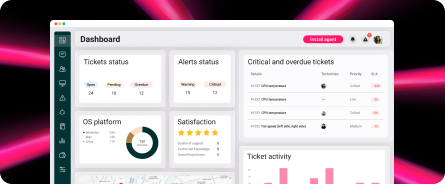
Atera’s admin dashboard
If problems arise during the onboarding, you can always contact Atera’s 24/7 customer support. Plus, we have a wide range of resources, including tutorials, a knowledge base, and an active IT community.
Pulseway has email and phone support, but it isn’t 24/7, which can make it difficult to get help quickly if something goes wrong.
3. Pricing and value for money
At Atera, we’re big advocates of transparent pricing. Thanks to our innovative per-technician pricing, all Atera users can manage unlimited endpoints for a fixed monthly cost.
Here are our pricing plans laid out:
Atera pricing for IT departments:
- Professional: $149 per month, per technician
- Expert: $189 per month, per technician
- Master: $219 per month, per technician
- Enterprise: Custom quotation, contact sales to get the pricing
- Pro: $129 per month, per technician
- Growth: $179 per month, per technician
- Power: $209 per month, per technician
- Superpower (Enterprise): Custom quotation, contact sales to get the pricing
4. Customer reviews and ratings
Atera’s G2 Rating: 4.6 out of 5 stars (830+ reviews)
What Atera users are saying on G2:
- “Atera helps my team stay connected to our data workflow through its RMM software. It lets us manage critical data pipelines, especially on our servers that run sensitive queries,” a G2 user says.
- “Atera is a powerful RMM software that we’ve integrated into our IT operations to manage endpoints, like computers, servers, and mobile phones,” a G2 user says.
Atera’s Capterra Rating: 4.6 out of 5 stars (430+ reviews)
What Atera users are saying on Capterra:
- “I have used Atera for many years now, and its handy features make it worth every penny. The monitoring is great when handling 100+ companies since I can prioritize based on the alerts received,” a Capterra user says.
- “I love that I can create custom scripts when I need something special, and it connects well with other services for extra security and backups,” a Capterra user says.
2. Syncro

Syncro is an RMM and PSA platform that small businesses mainly use to simplify their IT operations. Syncro recently introduced its XMM feature, which helps to simplify Microsoft 365 multi-tenant management.
Most of Syncro’s cons on G2 are related to feature limitations, which indicate that many of the features are still being developed. This is the main reason it’s used by SMBs who just need the essentials for IT management.
Enterprises and mid-sized businesses looking for scalable IT management solutions may quickly find that Syncro cannot keep up with their growth.
G2 Rating: 4.5 out of 5.0 (300+ reviews)
Capterra Rating: 4.6 out of 5.0 (75+ reviews)
Syncro Pricing:
- Core Plan: $139 per month, per user
- Team Plan: $189 per month, per user
3. Domotz

Domotz’s main use case is infrastructure monitoring. It automatically discovers and identifies new devices, maps device relationships, and offers a complete asset inventory view. Thanks to these capabilities, you can spot issues before they impact your network performance.
Looking into customer reviews of Domotz, we see that the platform is mainly known for its ease of use. Those with little or no experience with RMM platforms will likely have no problem using it. As a downside, customers complain that Domotz is expensive to use. The main reason is Domotz’s pay-per-device pricing model, which is expensive for companies with multiple devices.
G2 Rating: 4.9 out of 5.0 (90+ reviews)
Capterra Rating: 4.9 out of 5.0 (110+ reviews)
Domotz Pricing:
- Domotz Free: Free for managing one device
- Domotz Pro: $1.50 per managed device, per month
4. ConnectWise Automate

ConnectWise Automate helps IT teams automate manual processes and as a result, enhance their effectiveness. You can automatically discover new devices, monitor IT issues in real-time, and automate remediation actions. To manage tickets, you can integrate ConnectWise Automate with Manage.
ConnectWise can handle complex processes and is known for being capable of a lot. However, many ConnectWise Automate users mention that the product isn’t updated anymore, which means the interface is outdated compared to competitors.
G2 Rating: 4.1 out of 5.0 (130+ reviews)
Capterra Rating: 4.2 out of 5.0 (135+ reviews)
ConnectWise Automate Pricing:
- The pricing is pay-per-device. To get the pricing for your organization, you need to request a quotation from ConnectWise’s team
5. LogMeIn Resolve

Similarly to Syncro, LogMeIn Resolve is mainly used by small businesses that need an affordable RMM tool. It allows IT teams to remotely monitor and manage their network infrastructure, endpoints, and devices. It also monitors the real-time health and performance of servers and other network components. One of its strong points is LogMeIn’s own remote access tool, GoToMyPC, which is included in all plans.
Small businesses looking for an easy-to-use Pulseway alternative may find LogMeIn Resolve a suitable solution. LogMeIn Resolve is most likely not powerful enough for growing IT teams that require a robust RMM solution with a ticketing system, reporting, and patch management capabilities.
G2 rating: 4.4 out of 5.0 (430+ reviews)
Capterra rating: 4.4 out of 5.0 (200+ reviews)
LogMeIn Resolve Pricing:
- Remote Access and Support: $44/month for 100 devices, billed annually
- Standard Endpoint Management: $57/month for 25 devices, billed annually
- Premium Endpoint Management: $63/month for 25 devices, billed annually
6. NinjaOne

Like few other Pulseway alternatives, NinjaOne is an IT management tool that combines device management, patch management, and remote access into one platform. Users looking for customizable RMM software may find NinjaOne a good alternative to Pulseway. NinjaOne recently also added a simple PSA tool to its offerings.
One downside of NinjaOne is that it doesn’t incorporate Agentic AI into its platform. This is something few NinjaOne alternatives (like Atera) do, which helps IT teams manage their environments more efficiently.
G2 Rating: 4.7 out of 5.0 (2,000+ reviews)
Capterra Rating: 4.8 out of 5.0 (220+ reviews)
NinjaOne Pricing:
- NinjaOne requires you to contact their sales team to get the pricing. To do this, you can fill out a form on their website.
7. Kaseya VSA

Kaseya (the parent company of Pulseway) has different products for IT management, but the most popular is Kaseya VSA. With it, you can manage workstations, servers, and other devices, deploy patch updates automatically, and remtoely access devices.
Kaseya VSA users report similar downsides to Pulseway: the onboarding and customer support. This makes sense, as they’re owned by the same company. Customers on G2 mention that the onboarding fees are high, and onboarding trainers aren’t always genuinely interested in helping you.
G2 Rating: 4.0 out of 5.0 (300+ reviews)
Capterra Rating: 4.1 out of 5.0 (200+ reviews)
Kaseya VSA Pricing:
8. Naverisk

Naverisk is an all-in-one IT and service desk solution that combines remote monitoring and management, patch management, and basic automation into one tool. Unlike Pulseway, it is an entirely web-based RMM solution, and users do not have access to a mobile app.
Customers say Naverisk’s ticketing system is its main drawback. Many G2 users say it is difficult to locate old tickets that teams worked on previously and that searching for specific tickets is clunky.
G2 Rating: 4.7 out of 5.0 stars (65+ reviews)
Capterra Rating: 4.8 out of 5.0 stars (95+ reviews)
Naverisk Pricing:
- Based on a custom quote. To get the pricing, fill in a form on Naverisk’s website, and their team will contact you.
9. Jira Service Management

Jira Service Management provides IT service management capabilities, which help dev and operations teams respond to incidents and requests more quickly.
One drawback to Pulseway was its steep pricing structure. In comparison, Jira Service Management is quite affordable, and there is even a free version that allows really basic IT service management. However, Jira Service Management does not offer the advanced RMM capabilities, patch management, and PSA tools most IT teams need.
G2 rating: 4.2 out of 5.0 (780+ reviews)
Capterra rating: 4.5 out of 5.0 (700+ reviews)
Jira Service Management pricing:
- Free: Free for up to 3 agents
- Standard: $23.80 per month, per agent
- Premium: $53.30 per month, per agent
- Enterprise: Pricing based on custom quotation. Visit their website to learn more.
10. Freshservice

Freshservice is known as a cost-effective ticketing tool mainly for small to medium-sized businesses. Its main features are a ticketing system, knowledge base management, self-service portal, and a simple asset tracking tool. Freshservice belongs to the Freshworks product family, and it integrates well with other Freshworks products.
Freshservice is similar to Jira Service Management in that it covers the basic ITSM needs for IT teams. If you’re looking for a Pulseway alternative that can manage IT issues and assets and provide basic IT automation that reduces your workload, Freshservice may be a good option. However, it doesn’t provide the RMM capabilities most IT teams are looking for.
G2 Rating: 4.6 out of 5.0 stars (1,250+ reviews)
Capterra Rating: 4.5 out of 5.0 stars (600+ reviews)
Freshservice Pricing:
- Starter: $19/month/agent
- Growth: $49/month/agent
- Pro: $95/month/agent
- Enterprise: Based on a custom quotation
11. ManageEngine Endpoint Central

If you need a Pulseway alternative for endpoint management, ManageEngine Endpoint Central is a popular choice. It gives you the tools for monitoring and managing desktops, laptops, servers, mobile devices, and tablets from one interface.
Since Endpoint Central is exclusively focused on remote management, it is more effective for that purpose than Pulseway. It’s also known as an affordable solution, starting at just $104 for 50 endpoints.
G2 Rating: 4.4 out of 5.0 (900+ reviews)
Capterra Rating: 4.6 out of 5.0 (1000+ reviews)
ManageEngine Endpoint Central Pricing:
- Professional: Starts at $104 for 50 endpoints
- Enterprise: Starts at $124 for 50 endpoints
- UEM: Starts at $139 for 50 endpoints
- Security: Starts at $205 for 50 endpoints
Different add-ons on ManageEngine can increase the price.
Find the right Pulseway alternative for your needs
Now that we have reviewed the top Pulseway alternatives, you should have a better grasp of what the top alternatives are. But at the end of the day, you’ll need to decide what’s best for you and your organization’s needs.
Need a cost-effective ticketing tool? A simple ticketing system might be enough. Need a tool for managing your entire IT infrastructure? An all-in-one IT management tool, like Atera, is the right choice. Atera combines RMM software, patch management, helpdesk, remote access, and network discovery into one, so you don’t need to invest in redundant software for IT management.
What’s more, Atera offers AI agents that can completely transform your IT management and eliminate 40% of your IT workload automatically.
Want to learn more? Don’t forget to take advantage of Atera’s 30-day free trial. If you have questions specific to your organization’s operations, contact our sales team for more information.
Now, let’s look at Pulseway, its specializations, and why IT teams are looking to switch away from it.
What is Pulseway?

Pulseway is an RMM/PSA software used by IT teams and MSPs to remotely monitor, manage, and control their IT infrastructure.
The company was founded in 2011, and its goal has been to develop an IT management tool for managing workstations, servers, and network devices.
Why look for a Pulseway alternative?
After reviewing Pulseway customer reviews on G2 and Capterra, we found that customers were unhappy with the available customer support, changes since the Kaseya acquisition, and the pricing structure.
Here’s what customers said about these limitations:
1. Changes since the Kaseya acquisition
Kaseya has gradually acquired Pulseway, now owning 100% of it. Many customers aren’t happy with this, as Kaseya has a reputation for making drastic changes to the software they acquire.
One visible change after the acquisition is the push for 3-year contracts. Related to them, this is what one Reddit user said:

This is not all. Pulseway users recently got an email that Pulseway and Kaseya are joining forces, which means tighter integration with Kaseya’s ecosystem, and possibly more changes to come.
This is how one user commented on the changes Kaseya group has made to Pulseway:

Plus, in the past year, the free version of Pulseway was removed, illustrating the changes following the Kaseya acquisition.
2. Customer support quality has declined
Pulseway provides cross-platform support, meaning it has its own agents for Windows, Mac, and Linux. Support can be contacted by phone and email.
According to Pulseway customers, customer support quality has seen a decline in the past few years, possibly due to the Kaseya acquisition.
One Reddit user said, “Finally, my favorite issue is when you try to submit a problem to support. You can explain an issue fully and even provide a screenshot, and they will take a week to come back with a canned response.”

To this, another user responded:

This isn’t something just Reddit users complain about. Pulseway users on G2 also say the support is lacking and not available on the weekend.
Every IT professional who has been around the block once or twice knows the importance of customer support – it’s a no-brainer that it is crucial to choose an IT Ops platform with stellar support if something goes wrong. As a benchmark for what strong support should look like; you should look for a solution with 24/7 reliable support because an IT disaster can happen at any time.
3. Pricing structure limits scalability
Pulseway’s RMM pricing structure is based on pay-per-endpoint/device pricing. As a result, customers are charged for each new endpoint/device they add, which can quickly become expensive and prevent scaling profitably.
Pulseway has a pricing calculator on their website that reveals the true price. For example, if you manage 1000 endpoints, the cost is $3137 per month:

Pulseway pricing calculator
The per-endpoint pricing model makes it difficult for businesses to grow and scale without IT costs getting out of hand. Plus, Pulseway charges extra for features such as third-party patching and ransomware detection.
Not only this, users say that there have been sudden price increases in the past few years.
For example, one user said Pulseway got rid of server licensing, and their bill went up almost $800 a month:

As an alternative, you may want to look for a solution with per-technician pricing. This means you won’t be hit with surprise charges just because you add more endpoints.
What are Pulseway’s specializations?
Although these should be standard features in today’s IT software, two things Pulseway customers have reported on are ease of use and the available mobile app.
1. Ease of use
Pulseway’s main pro on G2 is its ease of use. Users say it’s very easy to deploy and organize, and the integrations with third-party tools are useful.
2. Available mobile app
Pulseway customers on G2 have reported that the mobile app is easy to use and has most of the same features as the Windows version. This is beneficial to those who wish to manage their IT environments from their mobile devices.
The pros and cons of Pulseway
To summarize the two previous sections on Pulseway’s specialties and limitations, see the following bullet points.
The pros, according to customers:
- Pulseway’s setup process is straightforward, and the software is simple to use
- Pulseway has a fully-featured mobile app that allows remote monitoring and management via a mobile device.
The cons, according to customers:
- The quality of Pulseway’s customer service has declined in recent years
- Customers aren’t happy with the changes after the Kaseya acquisition
- Pulseway’s pay-per-endpoint pricing model gets expensive quickly and prevents scaling
Frequently Asked Questions
Related Articles

The 7 Best Patch My PC Alternatives in 2026
Discover the best Patch My PC alternatives. Compare them across pricing, features, AI, and user reviews. See which option works best for your organization.
Read now
The 7 Best Rev.io Alternatives Your IT Team Can Use In 2026
Learn about the best Rev.io alternatives that modern IT teams use. See how they compare across features, pricing, user reviews, and AI.
Read now
Top 7 Aisera Alternatives for 2026
Learn about the best Aisera alternatives. See how they differ across features, Agentic AI, pricing, and user reviews.
Read now
7 Best Autotask PSA Alternatives for 2026
Find out the best Datto Autotask PSA alternatives. See how they compare across features, pricing, user reviews, and Agentic AI.
Read nowEndless IT possibilities
Boost your productivity with Atera’s intuitive, centralized all-in-one platform