Generate summary with AI

Network monitoring tools play a crucial role in maintaining any IT infrastructure’s health, performance, and security. They keep track of network traffic and notify users of unusual occurrences to ensure a network runs smoothly at all times.
Paessler PRTG is a popular choice in the arena of network monitoring software. Its strengths include customizable IT monitoring capabilities and effective alerting. But like any tool, it also has its drawbacks. The reported negatives include a cluttered user interface, a long learning curve, and a high price point.
11 best Paessler alternatives for network monitoring in 2026
Here are the key features, user compatibility, and pricing options for the best Paessler alternatives.
You can use this information to choose the right network monitoring tool.
1. Atera

Atera vs. Paessler: Key differences
1. Used for: Atera is an Agentic AI, IT management tool that enables network monitoring of SNMPs, laptops, Mac devices, Windows devices, printers, servers, routers, Linux machines, ports, and websites. You can set up alerts for three different network statuses: informational, warning, and critical, and alerts can be sent to you by email, so you’re always up-to-date on any critical situations.
In comparison, Paessler’s primary purpose is network monitoring. It enables users to monitor the status and health of their devices.
2. Agentic AI: Atera’s main advantage is its Agentic AI technology, which expands to its entire platform, helping IT teams move from reactive to preemptive problem resolution.
We’re recognized as leaders in the AIOps market, and G2 selected Atera as the #1 best AIOps tool for 2026. Looking into G2’s comparison graph, we can see Atera clearly leading the AIOps market:
In comparison, Paessler recently launched its first AI feature, but it’s mainly limited to anomaly detection.
With Atera, our autonomous IT agents expand to all areas of IT management, allowing you to reason, plan, take action, and continuously improve to keep your organization ahead.
3. User interface: Atera is renowned for its intuitive user interface, which allows users to get up and running quickly. Atera customers laud this ability—we have won a G2 award for both ease of use and implementation. In contrast, reviews related to Paessler’s interface often report that it’s cluttered, making the platform difficult to learn.
Features and capabilities
Atera is the only Paessler alternative that incorporates a true Agentic AI technology into its platform, capable of eliminating 40% of your IT workload instantly.
You may have grown accustomed to handling routine monitoring, troubleshooting, and maintenance tasks manually, but Atera’s AI agents can fully autonomously perform these tasks.
With Atera’s Robin handling 80% of your first-tier support, first-time response times are reduced to zero, and you can ensure seamless operations even outside of business hours.
Autopilot resolves tickets, diagnoses and fixes device issues, handles routine and complex tasks, and installs pre-approved software on your end-users’ devices, so your IT team can shift from support to priority projects.
What’s best, it does this on channels your end-users already live in, whether its Slack, email, Teams, or your Customer Portal.
Unlike most AI agents, Autopilot doesn’t just respond to user queries; it’s capable of fixing them. These may include resetting passwords, updating drivers, patching vulnerabilities, or even handling more complex issues like troubleshooting network connectivity issues.
For more complex (or plain weird) issues that require more attention, Autopilot automatically escalates them to a human technician, with full context of the issue.
For technicians who deal with manual and repetitive tasks, Atera’s AI Copilot comes in handy.
The capabilities of Copilot are spread across Atera’s platform, and you can use it to:
- Run health checks, diagnose, suggest actions, and resolve issues on your macOS and Windows devices
- Turn simple instructions into powerful scripts using Copilot’s AI script generator
- Describe the problem in simple words, and Copilot turns it into the right command
- Get instant summaries of every ticket and suggestions for resolving them
- Turn ticket resolutions into ready-to-use KB articles
In addition to our autonomous IT agents, Atera’s Network Discovery tool comes in handy. It
automatically maps out your IT infrastructure, scanning for hardware, software, and potential vulnerabilities. This ensures that your IT environment stays secure and up-to-date.

Paessler provides similar network monitoring capabilities, but since its sole focus is on network monitoring, it excludes other essential IT management features.
At Atera, we are also proud of our large suite of third-party integrations, which we have helpfully categorized into groups like security, remote access, SSO, documentation, networking monitoring, and more. Some of our fan-favorite integrations include remote access options like Splashtop and AnyDesk, big-name security players like Keeper and Ironscales, and classic IT favorites such as Chocolatey and IT Glue. These integrations further enhance the versatility and functionality of our already impressive platform.
User interface and usability
Atera is widely regarded as an easy-to-use and intuitive IT management platform, and new users are up and running within minutes.

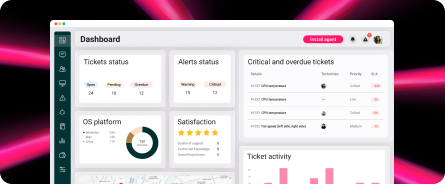
Atera’s dashboard view
One G2 user commented on Atera’s intuitive user interface, “The shared dashboard makes it easy to track performance and spot any security issues in real time. It also helps the team to communicate directly with IT by creating and managing support tickets when needed.”

When comparing Atera’s interface to Paessler, users on different review platforms, including G2, have reported that it is cluttered, which is particularly problematic in large IT environments.
Part of our usability and quick learning curve also boils down to customer support. We give our users the ultimate collection of resources to fully take advantage of our platform and ensure they can get help whenever they need it. In addition to asynchronous resources like our knowledge base, blog posts, and webinar collection, we have also expanded our commitment to IT education with our exciting new game, Apollo IT.
Pricing plans and value for money
Despite offering similar network monitoring capabilities, Atera and Paessler price their services differently.
Atera uses pay-per-technician pricing, where you pay a fixed price regardless of how many endpoints/devices you manage. The pricing plans range from $149 to $199 per month for IT departments and from $129 to $209 per month for MSPs. With all available plans, you can manage unlimited devices/endpoints.

Atera’s IT department pricing
Here are Atera’s pricing plans laid out:
Atera pricing plans for IT departments:
- Professional: $149 per month, per technician
- Expert: $169 per month, per technician
- Master: $219 per month, per technician
- Enterprise: Custom quotation; contact sales to get pricing
- Pro: $129 per month, per technician
- Growth: $179 per month, per technician
- Power: $209 per month, per technician
- Superpower (Enterprise): Custom quotation. Contact sales for pricing.
Conversely, Paessler’s pricing plans are based on pay-per-device/aspect, where the price rises as you manage more aspects of a device. This can quickly get expensive, especially if you have a small team but still manage large amounts of devices.
Plus, Paessler’s features don’t bring the same efficiency gains that IT teams can achieve with Atera.
With Atera Autopilot handling first-tier support and Copilot empowering your technicians, you can achieve faster resolutions, higher ticket throughput, and significantly lower operational overhead.
User reviews and rating
Atera’s G2 Rating: 4.6 out of 5 stars (840+ reviews)
Paessler’s G2 Rating: 4.6 out of 5 stars (80+ reviews)
What Atera users are saying on G2:
- “Atera AI integrations really help our Level 1 technicians to succeed. The automation of scripts on alerts and Copilot pointing technicians in the right direction makes Atera a cut above the rest,” a G2 user says.
- “The AI Assistant is constantly improving and has offered several helpful scripts. They constantly develop on the entire platform, with new features coming out frequently,” a G2 user says.
Atera’s Capterra Rating: 4.6 out of 5 stars (430+ reviews)
Paessler’s Capterra Rating: 4.6 out of 5 stars (230+ reviews)
What Atera users are saying on Capterra:
- “Incorporating Atera’s AI assistant has brought about a delightful change in automating my operations. I have benefited from reduced wasted time on issues that could have taken me a lot of time to figure out by myself, while the AI comes up with a solution,” a Capterra user says.
- “Atera is helping us solve tickets in a very short space of time using their Copilot in the PSA that analyses a ticket, suggests solutions, and helps respond professionally,” a Capterra user says.
2. Domotz

Domotz is a network monitoring software designed to help IT departments and MSPs monitor, manage, and troubleshoot any network remotely. Its real-time alerting system constantly monitors device changes and alerts IT technicians when changes or new devices appear, ensuring network security.
Domotz is known for its user-friendly software. However, its features are limited to network monitoring—an understandable drawback. That said, it can be integrated with third-party software for more functionalities. If you’d like to use Domotz alongside an all-in-one IT management solution, Atera directly integrates with Domotz.
G2 Rating: 4.8 out of 5.0 (80+ reviews)
Capterra Rating: 4.9 out of 5.0 (100+ reviews)
Domotz Pricing:
- Enterprise: Starting at $1,000 per month
- Pro: $35 per month per site
3. ConnectWise Automate

ConnectWise Automate allows IT professionals and MSPs to monitor and manage IT environments remotely. It offers features such as real-time alerting and monitoring, patch management, remote access, reporting and analytics, and more. To enhance its functionality, ConnectWise RMM can be integrated with other ConnectWise products, such as ConnectWise PSA.
If you want a solution capable of more than network monitoring, ConnectWise is a suitable option. ConnectWise’s major drawback is its complexity, which stems from its large number of features that small businesses do not need.
G2 Rating: 4.1 out of 5.0 (130+ reviews)
Capterra Rating: 4.1 out of 5.0 (130+ reviews)
ConnectWise Automate Pricing:
- Custom quotation: To find out the pricing for ConnectWise Automate, you need to request a quotation from their team
4. N-able

N-able’s flagship product, N-sight, provides real-time monitoring and management of network devices. It aims to be an all-in-one IT management solution and offers features such as RMM, patch management, mobile device management, remote access, ticketing and billing, and more.
N-sight uses a pay-per-endpoint pricing model–which unfortunately can add up. G2 users also mention difficulties with N-sight’s onboarding process, citing it as counterintuitive and laborious. Users who are looking for a solution with easy integration will want to explore other modern IT management options.
G2 Rating: 4.3 out of 5.0 (290+ reviews)
Capterra Rating: 4.3 out of 5.0 (70+ reviews)
N-sight Pricing:
- Basic plan: Starting at $99 per month
5. ManageEngine OpManager

OpManager is ManageEngine’s network monitoring tool. Users can track device health in real-time and gain visibility into the performance of servers, VMs, printers, storage devices, routers, switches, and firewalls. OpManager also has built-in troubleshooting capabilities with configuration management and planning.
OpManager is entirely focused on network monitoring, but it can be integrated with other ManageEngine products and third-party apps for more features. The downside of this capability is the increased cost compared to an all-in-one solution, such as Atera.
G2 Rating: 4.4 out of 5.0 stars (100+ reviews)
Capterra Rating: 4.6 out of 5.0 stars (100+ reviews)
ManageEngine OpManager Pricing:
- Custom quotation. Contact ManageEngine’s sales team for pricing options.
6. SolarWinds NPM

SolarWinds NPM is a network monitoring and management solution for IT professionals and network administrators. It enhances the performance and availability of a network infrastructure by providing insight into its health. Key features include network mapping, a device poller, advanced alerting, reporting, and a syslog and SNMP trap server.
SolarWinds NPM is focused on network monitoring in IT management, but it can be integrated with other third-party software for more features.
G2 Rating: 4.3 out of 5.0 stars (700+ reviews)
Capterra Rating: 4.5 out of 5.0 stars (70+ reviews)
SolarWinds NPM Pricing:
- Custom quotation with prices starting at $1,856. Visit their website for an exact quote.
7. LogicMonitor

LogicMonitor is cloud-based network monitoring software providing real-time information on network device performance. With features such as network logs, metrics, and threshold alerts, LogicMonitor makes it easy to troubleshoot network issues.
LogicMonitor is a highly capable network monitoring solution, but it does have some drawbacks. Users complain about interface challenges similar to those exhibited by Paessler, such as a cluttered dashboard view that isn’t streamlined.
G2 Rating: 4.5 out of 5.0 stars (600+ reviews)
Capterra Rating: 4.6 out of 5.0 stars (100+ reviews)
LogicMonitor Pricing:
- Infrastructure monitoring: Starting from $22/month, per resource
- Cloud IaaS monitoring: Starting from $22/month, per resource
8. NinjaOne

NinjaOne’s RMM offers a broad range of RMM capabilities, including built-in network monitoring. This allows IT departments and MSPs to monitor and manage networks in real-time, follow hardware performance data, and uncover network issues through the available alerting conditions. NinjaOne also has patch management functionality that helps deploy patches to devices automatically. However, NinjaOne does not offer PSA functionality natively, so if you are looking for a true all-in-one solution, it may be best to consider an alternative like Atera.
Similarly to Paessler, NinjaOne uses a pay-per-device pricing model. The price increases with the addition of devices. Many consumers consider this a drawback and prefer a pay-per-technician model like Atera’s.
G2 Rating: 4.7 out of 5.0 (1,600+ reviews)
Capterra Rating: 4.8 out of 5.0 (200+ reviews)
NinjaOne Pricing:
- Pricing is based on custom quotation. To learn more, visit their website.
9. Auvik

Auvik is a network monitoring and management tool for MSPs and IT departments. It helps users gain network visibility through real-time maps that update automatically. Auvik aims to simplify network management by providing automated network discovery, real-time monitoring, and troubleshooting tools (such as pre-configured alerts and logs).
Users describe Auvik as ideal for mapping out networks and providing a tool for monitoring client networks.
G2 Rating: 4.5 out of 5.0 stars (300+ reviews)
Capterra Rating: 4.6 out of 5.0 stars (70+ reviews)
Auvik Pricing:
- Custom quotation. Contact Auvik’s sales team via their website for exact pricing.
10. Dynatrace

Dynatrace provides network monitoring solutions for IT environments. Its cloud monitoring tool paints a full picture of your IT environment’s health in order to eliminate blind spots. Users can observe all cloud and on-premise tiers, including critical network metrics and OS-level metrics.
Numerous Dynatrace customers mention that the software is highly customizable, a capability reflected in its high pricing. On that note, some G2 users say that the available customer support doesn’t match the high price that Dynatrace has. Many other solutions, including Atera, provide 24/7 live chat, so this is a noticeable limitation.
G2 Rating: 4.5 out of 5.0 stars (1,300+ reviews)
Capterra Rating: 4.5 out of 5.0 stars (50+ reviews)
Dynatrace Pricing:
- Pricing is determined by the amount of usage. Initial price points begin at $0.08 per hour for an 8 GiB host for full-stack monitoring.
11. SysAid

SysAid is an IT service management platform with network monitoring, help desk, IT automation, asset management, and problem/incident management capabilities. By creating monitoring configurations, SysAid allows users to monitor computer and SNMP assets proactively. Users can extend SysAid’s functionality with third-party integrations.
Like Atera, SysAid uses AI to power its platform. Currently, SysAid’s AI is mainly used to assist with the help desk, and it comes with features such as AI-based summarization and suggestions.
G2 Rating: 4.5 out of 5.0 stars (600+ reviews)
Capterra Rating: 4.5 out of 5.0 stars (400+ reviews)
SysAid Pricing:
- Based on custom quotation. Book a demo call with SysAid to receive pricing.
Agentic AI, all-in-one IT management with Atera
Atera’s network monitoring tool allows you to monitor the status and health of devices and networks. In addition to network monitoring, Atera offers many other desirable IT features, including strong remote monitoring and management (RMM), PSA, IT ticketing, patch management, remote access, and all powered by our Agentic AI technology.
Instead of spending money on various software solutions, Atera provides an all-in-one solution for managing your IT infrastructure. Plus, Atera’s autonomous IT capabilities shine in our two AI agents, Robin and AI Copilot, which enable 10X efficiency for technicians and up to 40% of your IT workload to be eliminated instantly.
If you want to try Atera, you can contact our sales team for a demo or sign up for a 30-day free trial—no credit card required.
To help you choose the network monitoring tool that’s right for you, here are the pros and cons of Paessler PRTG:
What is Paessler PRTG?

Paessler’s flagship product, Paessler PRTG, is a network monitoring solution that monitors the performance, availability, and health of network devices, applications, and IT infrastructure. Paessler offers dedicated network monitoring tools for small and medium-sized IT teams, as well as enterprises that need more advanced capabilities.
But for some Paessler users, the software doesn’t quite hit the mark when it comes to their organization’s IT and RMM needs, leading them to search for an alternative. And that’s where we step in, we’re going to teach you everything you need to know when it comes to Paessler PRTG and the available alternatives.
Why look for a Paessler alternative?
After evaluating the customer reviews of Paessler users, we found that the platform’s main limitations include its cluttered user interface, long learning curve, and high product cost. Let’s take a closer look at that feedback.
1. A cluttered user interface
One Capterra user shares that Paessler’s interface is a bit overwhelming and there are occasional false alarms. A G2 user shares that concern, and points out that it takes a while to get sorted out through the information. Given the modern IT management solutions available in today’s market, a poor user interface is a notable disadvantage.
Here’s another important point: Paessler may have a cluttered interface, which implies that it’s an all-in-one IT solution, but it’s not. For instance, Paessler does not offer PSA functions like some other more well-rounded competitors on the market. In other words, the cluttered interface is not a result of enhanced functionality… making it a tradeoff that doesn’t work out in your favor, in our opinion.
2. Long learning curve
Users on Capterra highlight Paessler’s complex learning curve as a potential drawback. For instance, one Capterra user wishes for a more streamlined configuration to facilitate faster deployment:

Paessler review via Capterra
For teams new to network monitoring tools, a steep learning curve can negatively impact the product’s efficacy and efficiency.
Now, a lengthier learning curve might not be an issue if Paessler had stronger support offerings. If you run into issues getting to know the platform, you may have questions that you’ll want to ask a support team.
There have been some complaints from Paessler customers that the support is slow to respond:

Paessler review via Capterra
As you consider the best networking monitoring solution for your IT team, it’s important to look for a platform that offers around-the-clock support through live agents as well as asynchronous tools. For instance, you might appreciate a platform that has numerous blogs, a knowledge base, and even live and on-demand webinars for you to learn at your own pace and troubleshoot different issues as they arise.
3. High product cost
Paessler’s pricing plan depends entirely on the number of devices and aspects you manage. The more you have, the more expensive it becomes.
On top of this, Paessler has recently increased their prices dramatically, which resulted in customer complaints. One Reddit user even mentions that their annual subscription cost increased by 300%:

Paessler review via Reddit
Many users replied that they’re not renewing with Paessler due to the increased costs.
For most IT teams, the steep pricing and increases are a significant disadvantage, especially when alternatives like Atera offer pricing that allows to manage unlimited devices through pay-per-technician pricing.
What are Paessler’s strengths?
Paessler’s two main strengths are its flexibility and effective alerting system. Here’s more information on each of these capabilities.
1. Automatic device discovery
Upon onboarding, Paessler automatically maps out your IT environment and lists your devices, which a G2 user appreciated.
2. Effective alerting system
According to one G2 user, Paessler effectively alerts an organization when systems go down. Although there are positive reviews regarding Paessler’s alerting features, they’re not necessarily a standout feature since most alternatives offer the same functionality.
Paessler pros and cons: Takeaways
According to customer reviews, the pros and cons of Paessler are as follows.
The pros:
- Automatic device discovery upon onboarding
- Provides alerting features for monitoring device uptime
The cons:
- The learning curve is long
- High product cost due to the available pay-per-device pricing
- A cluttered user interface, which is especially problematic for larger IT environments
- Limited developments in the AI-powered IT space, which other competitors have brought to the market.
Frequently Asked Questions
Related Articles

The 7 Best Patch My PC Alternatives in 2026
Discover the best Patch My PC alternatives. Compare them across pricing, features, AI, and user reviews. See which option works best for your organization.
Read now
The 7 Best Rev.io Alternatives Your IT Team Can Use In 2026
Learn about the best Rev.io alternatives that modern IT teams use. See how they compare across features, pricing, user reviews, and AI.
Read now
Top 7 Aisera Alternatives for 2026
Learn about the best Aisera alternatives. See how they differ across features, Agentic AI, pricing, and user reviews.
Read now
7 Best Autotask PSA Alternatives for 2026
Find out the best Datto Autotask PSA alternatives. See how they compare across features, pricing, user reviews, and Agentic AI.
Read nowEndless IT possibilities
Boost your productivity with Atera’s intuitive, centralized all-in-one platform