Table of contents
Table of contents
- The 11 best Kaseya alternatives for IT teams in 2026
- 1. Atera
- 2. Syncro
- 3. Datto
- 4. Pulseway
- 5. Superops
- 6. ManageEngine
- 7. ConnectWise Automate
- 8. NinjaOne
- 9. Freshservice
- 10. Microsoft Intune
- 11. N-able
- The only Kaseya alternative with Agentic AI technology – Atera
- What is Kaseya?
Generate summary with AI

In the ideal scenario, your IT management software should allow you to manage your network infrastructure remotely and proactively identify and fix any IT issues. And when it comes to all-in-one IT management solutions, expectations rise even more.
Kaseya is known as a trusted IT management solution, but many IT departments are actively seeking alternative solutions that better suit their needs.
Not all software is created equal, so it makes sense to look for stronger alternatives. To help you with that, we have reviewed the top 11 Kaseya alternatives that IT teams should consider in 2026.
The 11 best Kaseya alternatives for IT teams in 2026
Let’s now review the 11 best Kaseya alternatives IT teams can use in 2026.
1. Atera

Atera Vs. Kaseya: Key differences
1. Key features: Both Atera and Kaseya VSA are IT management solutions for enterprises and SMEs. The key features include RMM software, patch management for all OS, remote access for troubleshooting, ticket management, and network discovery.
All of Atera’s features are included in its all-in-one platforms. Comparatively, you may need to combine different Kaseya products to get the same functionality.
2. Agentic AI: Of the two, only Atera incorporates Agentic AI technology into its entire platform through its AI agents. Our innovative AI agents have been recognized, as we’re ranked #1 on G2’s best AIOps tools.
Atera’s Robin takes on manual, repetitive tasks off techs’ tables, eliminating 40% of the IT workload, while also tackling more complex issues.
3. Pricing: Atera and Kaseya have two different RMM pricing plans. Atera’s pricing is pay-per-technician, which lets you manage unlimited endpoints for a fixed fee. Comparatively, Kaseya charges based on the number of endpoints you have, which can quickly get expensive. Plus, the pricing is based on a custom quotation, which makes it hard to compare with Atera.
4. Security: Both Atera and Kaseya take security seriously and are major players in the IT space. At Atera, we’re constantly developing and enhancing our cybersecurity offerings. While the same is true for Kaseya, they have received some major complaints from customers regarding their security procedures. At Atera, we are proud to hold numerous security certifications and compliances that help our clients trust in our commitment to security. Our platform is GDPR compliant, AICPA SOC2 compliant, and HIPAA compliant.
We also hold a variety of ISO certifications, including 27001, 27017, 27018, and 27032.
For an in-depth comparison of Atera and Kaseya, including user reviews and performance insights, check out the comparison table below:

You can check out the full analysis here. This report will guide you in selecting the best tool for your IT management requirements.
Tip: Read our in-depth Atera vs Kaseya review here.
Features and capabilities
In the G2 comparison of Atera and Kaseya, users rated Atera higher across all categories, which included endpoint management, RMM, service desk, patch management, and more.
Another added benefit of Atera is its AI agents: AI Copilot and Robin.
Robin is there to empower end-users in resolving issues on their own, while Atera’s AI Copilot works alongside technicians, expanding their human expertise and capabilities.
Atera Copilot assists with tasks, like:
- Getting insights: Access key information across your entire account and get key device insights on demand.
- Troubleshooting devices: Run health checks, diagnose, suggest actions, and resolve issues on your devices
- Responding to tickets: Get instant ticket summaries and let Copilot automatically handle responding to them.
- Generating scripts: Turn plain-text instructions into scripts in seconds. Simply explain to Copilot the type of scripts you need.
Atera’s AI agents can be truly baked into every part of your IT workflow, helping you to move from automated to fully autonomous IT.
Our enterprise customers, like Leeds United, already use Atera’s AI agents and reap the benefits, like a 35% reduction in IT tickets.
User interface and basic usability
Atera has won G2 recognition as a top-rated platform for ease of use and implementation. Compared to Kaseya, whose customers have complained that it is difficult to use and that the user interface is outdated.
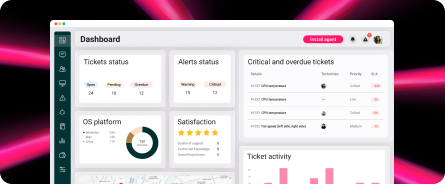
Atera’s user interface is created with ease of use in mind. To show you what it looks like, here is an overview of it:

Atera’s admin dashboard view
Not only does Atera provide an intuitive interface for monitoring and securing devices, but we also offer a complete PSA solution with a helpdesk, billing system, and reporting tools.
On top of the cloud-based desktop version, Atera offers a mobile app for remote problem-solving and ticket handling from Android and Apple devices.
Security and compliance
Atera has a strong reputation for security and compliance, and we are proud to compete against all the major players in this field. Kaseya has mostly earned a positive reputation for its security, but they have also had security problems, which have decreased customers’ trust.
Our goal at Atera is to help our customers increase their security (security hardening). To do that, we provide features such as patch management to ensure systems are always up-to-date, remote monitoring and management to detect vulnerabilities, antivirus and malware protection, automation of security tasks, and permission control.
In addition, Atera’s Network Discovery tool offers a comprehensive security scan of all end-user networks and devices, giving you a complete picture of what’s happening.

Community and support
Support is another area where Atera excels over Kaseya. Kaseya customers complain that getting a response can take days or even weeks. With Atera, you can expect a first response within minutes, thanks to our 24/7 live chat and email support. We also have a robust knowledge base, which you can use to find help for issues.
We’re all about supporting our users in learning more about Atera, new features, and even more general topics in the world of IT.
Another way we keep our commitment to community and learning strong? Our IT Game called Apollo IT. This game is truly one-of-a-kind and provides a training ground for new IT hires as well as those looking to refresh their skill sets. By interacting with an AI bot, you will be able to tackle IT-related challenges to hone your logic and problem-solving skills. Check out Apollo IT today… but be careful, you might get hooked!
Customer reviews and pricing
Atera’s G2 Rating: 4.6 out of 5.0 stars (830+ reviews)
Kaseya VSA’s G2 Rating: 4.1 out of 5.0 stars (300+ reviews)
What Atera users are saying on G2:
- “Atera is a powerful RMM software that we’ve integrated into our IT operations to manage endpoints, like servers, computers, and mobile phones,” a G2 user says.
- “Apart from RMM, Atera also excels in other areas. We can see the configuration of devices, schedule patch updates, and test them before deployment,” a G2 user says.
Atera’s Capterra Rating: 4.6 out of 5.0 stars (430+ reviews)
Kaseya VSA’s Capterra Rating: 4.1 out of 5.0 stars (200+ reviews)
What Atera users are saying on Capterra:
- “Atera’s monitoring is great when handling 100+ companies since I can work a priority out based on the alerts received,” a Capterra user says.
- “Atera is a great tool that makes managing IT tasks much easier. It has a script feature that lets me create custom solutions if something isn’t already included,” a Capterra user says.
Pricing and value for money
At Atera, we are committed to transparent pricing. We want you to be able to gain insight into what you will be paying before you commit to anything. That’s why we even offer a 30-day free trial to get acquainted with our software… no credit card required!
And what’s more, our plans include unlimited endpoints, so you’ll never be hit with a huge surprise on your bill when your endpoints spike up.
Atera pricing for IT departments:
- Professional: $149 per month, per technician
- Expert: $189 per month, per technician
- Master: $219 per month, per technician
- Enterprise: Custom quotation, contact sales to get the pricing
- Pro: $129 per month, per technician
- Growth: $179 per month, per technician
- Power: $209 per month, per technician
- Superpower (Enterprise): Custom quotation, contact sales to get the pricing
2. Syncro

Syncro combines PSA, RMM, help desk ticketing, and patch management capabilities into one platform. Since it’s primarily used as an MSP software by managed service providers (MSPs), it’s unique in that sense. However, IT departments may not find many of the features useful.
Syncro recently launched a Microsoft 365 multi-tenant management system, which automates Microsoft 365 compliance monitoring and risk assessments. This is especially helpful for MSPs.
G2 Rating: 4.5 out of 5.0 (300+ reviews)
Capterra Rating: 4.6 out of 5.0 (75+ reviews)
Syncro Pricing:
- Core Plan: $139 per month, per user
- Team Plan: $189 per month, per user
3. Datto

Datto (owned by Kaseya) offers various IT management products, such as Datto RMM and Autotask PSA. Datto RMM is focused on RMM capabilities, helping you monitor endpoints like desktops, servers, and mobile phones. Autotask PSA is primarily a ticketing system for MSPs.
Datto positions itself as an all-in-one IT solution, competing with other solutions in that field. It’s well known for providing advanced customization, but it does come at a cost, as many customers complain about the platform’s complexity.
G2 Rating: 4.5 out of 5 stars (650+ reviews)
Capterra Rating: 4.2 out of 5 stars (30+ reviews)
Datto Pricing:
- To get the pricing, you need to fill in a form and request pricing from Datto’s sales team.
4. Pulseway

Pulseway (also owned by Kaseya) is an RMM solution that enables IT professionals and MSPs to monitor and manage their IT systems remotely. Teams looking for a Kaseya alternative with strong RMM capabilities may find Pulseway suitable.
One of its advantages is the available mobile app for Apple and Android devices, which allows endpoint management on the go. Pulseway’s pricing is similar to Kaseya’s since they charge per endpoint/device. What customers didn’t appreciate about the pricing is that all new customers looking for Pulseway alternatives are required to pay an onboarding fee of $149 before getting access to the software.
G2 Rating: 4.6 out of 5.0 (110+ reviews)
Capterra Rating: 4.7 out of 5.0 (305+ reviews)
Pulseway Pricing:
- Pulseway has a pricing calculator on its website that you can use to calculate how much the pricing is for your situation
5. Superops

SuperOps aims to provide MSPs with a unified platform for managing their clients’ IT infrastructure. Like few other Kaseya alternatives, SuperOps competes in the all-in-one category with RMM, PSA, project management, remote access, and ticketing system features.
G2 Rating: 4.6 out of 5.0 stars (125+ reviews)
Capterra Rating: 4.5 out of 5.0 stars (30+ reviews)
SuperOps Pricing:
- MSPs: Starting at $129 per user, per month for the unified PSA and RMM package
- IT teams: Starting at $150 per month for 100 devices
6. ManageEngine

ManageEngine offers various products designed to help organizations manage their IT infrastructure. Their most popular product is Endpoint Central, which enables IT teams and MSPs to discover, manage, secure, and monitor all their clients’ devices from a single dashboard.
ManageEngine’s other products, such as AD360, ServiceDesk Plus, and AssetExplorer, help extend Endpoint Central’s capabilities. Third-party integrations are also available with tools like Slack, CrowdStrike, and Zendesk.
IT teams seeking ManageEngine alternatives for remote monitoring and management may find it a suitable solution over Kaseya.
G2 Rating: 4.4 out of 5.0 (880+ reviews)
Capterra Rating: 4.6 out of 5.0 (970+ reviews)
ManageEngine Endpoint Central Pricing:
- Professional: Starts at $104 for 50 endpoints
- Enterprise: Starts at $124 for 50 endpoints
- UEM: Starts at $139 for 50 endpoints
- Security: Starts at $205 for 50 endpoints
7. ConnectWise Automate

ConnectWise Automate is an RMM solution that automates the discovery, monitoring, and response to IT issues for multiple devices.
Similarly to ManageEngine, ConnectWise offers a suite of tools. If you also want PSA or remote access capabilities, you need to purchase multiple of their products. The downside is that you pay for multiple subscriptions rather than investing in one all-in-one IT solution, like Atera.
G2 Rating: 4.1 out of 5.0 (130+ reviews)
Capterra Rating: 4.2 out of 5.0 (135+ reviews)
ConnectWise Automate Pricing:
- The pricing is pay-per-device. To get the pricing for your organization, you need to request a quotation from ConnectWise’s team
8. NinjaOne

NinjaOne is an RMM and endpoint management solution for MSPs and IT professionals. Similarly to alternatives like Atera, NinjaOne is known for its robust features and world-class customer support.
NinjaOne does have RMM features, but lacks PSA capabilities, which may be problematic for MSPs. As a result, if you want PSA functionality, you will need to invest in third-party software, leading to higher costs compared to NinjaOne alternatives.
G2 Rating: 4.7 out of 5.0 (2,000+ reviews)
Capterra Rating: 4.8 out of 5.0 (220+ reviews)
NinjaOne Pricing:
- NinjaOne requires you to contact their sales team to get the pricing. To do this, you can fill out a form on their website.
9. Freshservice

Freshservice is an ITSM software by Freshworks that includes a ticketing system, asset and change management, and reporting capabilities. Being part of the Freshworks product family, it integrates well with their other products.
As a Kaseya alternative, it can be suitable if you only need the basic service desk and IT management features. Freshservice has asset management capabilities, but they’re known to be quite limited.
G2 Rating: 4.6 out of 5.0 stars (1,250+ reviews)
Capterra Rating: 4.5 out of 5.0 stars (600+ reviews)
Freshservice Pricing:
- Starter: $19/month/agent
- Growth: $49/month/agent
- Pro: $95/month/agent
- Enterprise: Based on a custom quotation
10. Microsoft Intune

Microsoft Intune is a unified endpoint management solution that helps IT teams protect devices against cybersecurity threats. It’s especially popular among IT teams who already operate in the Microsoft environment, as the integrations with other Microsoft products are native and easy to manage.
For multi-OS environments, Intune may not be the best option since it does not offer the same compatibility with macOS devices.
G2 Rating: 4.5 out of 5.0 stars (210+ reviews)
Capterra Rating: 4.6 out of 5.0 stars (35+ reviews)
Microsoft Intune pricing:
- Microsoft Intune Plan 1: Starting at $8 per month per user for unified endpoint management
11. N-able

N-able helps IT organizations remotely monitor, manage, and secure their networks, servers, and endpoints. While this is their main focus, they also have products for help desk ticketing, reporting, and billing management.
Since N-able’s features are divided into different products, customers must switch between them if they want more capabilities. A common complaint from customers was that they felt the products weren’t well integrated together.
G2 Rating: 4.4 out of 5.0 stars (500+ reviews)
Capterra Rating: 4.1 out of 5.0 stars (150+ reviews)
N-central Pricing:
- N-able doesn’t make the pricing public, but it’s based on the number of endpoints you manage. You need to “Contact a specialist” from their website to receive the pricing.
The only Kaseya alternative with Agentic AI technology – Atera
Atera’s AI agents represent a paradigm shift in how IT operates. Agentic AI is the foundational technology shaping the future of IT. Instead of shying away from it, bring your organization to the modern age and start reaping the benefits immediately.
The benefits from Atera’s AI agents are immediate:
- Up to 40% of your IT workload is eliminated
- Zero first response time with Copilot handling incoming tickets
- Faster resolution times. SLAs are slashed from hours to minutes
- 24/7 expert-level support from AI agents
- Minimal onboarding time; AI agents are ready in minutes
- Lower operating costs, as you don’t need to scale human support teams
Interested in trying how Atera’s AI agents can work for your organization? Get in touch with our sales team today and start your free 30-day free trial!
Get started today; no credit card is required!
Now, let’s look at Kaseya, including its limitations and strengths.
What is Kaseya?
Kaseya provides IT teams with tools for managing and securing their systems and networks. Kaseya is not just one product; it’s a suite of various tools. The most popular tool for IT departments is Kaseya VSA, which offers remote monitoring and management (RMM), remote control, and patch management.
Recently, Kaseya has attempted to make a mark with its new intelligence agent, “Cooper.” Its purpose is to help you get full usage out of Kaseya and direct you to complete the necessary next steps with support tickets, employee onboarding, and other processes.
Kaseya also introduced a new product called Kaseya 365, which allows users to combine Kaseya’s tools into one comprehensive product that the brand says provides everything needed to secure, automate, manage, and back up IT endpoints.
Why look for a Kaseya alternative?
To get a clear picture of Kaseya, we wanted to listen to its real customers and see what they find limiting (and good) about the platform.
We scoured G2, Capterra, Gartner, and Reddit and found that users say Kaseya’s IT automation is limited, customer support takes a long time to respond, and security standards are not trusted.
This is what users said about Kaseya’s limitations:
1. The automation features are limited/not working
A key purpose of an IT management tool is to make IT processes more efficient. Tasks like patch management, ticket responses, and script generation should all be partially (or even fully) automated.
Unfortunately, many Kaseya VSA users say they still need to perform tasks manually, either because automation is not available or the features do not work.
For example, see what this user said about patching with Kaseya:

Another IT admin who managed 1600 endpoints said, “I was only able to bring systems up to date by working after hours via remote desktop protocol and going around the Kaseya system.”

Kaseya aims to solve this issue with the new “Cooper AI” assistant. But at least for now, the AI is mainly limited to responding to tickets and assisting with creating documentation.
2. Inconsistent customer service experience
When you’re facing issues, the ideal IT management tool gets you up and running within hours, not days or weeks.
A common complaint from Kaseya customers was the delayed support, and users mentioned “waiting weeks to get the solution.” This is what one G2 user said:

If you have a more complex issue and need to escalate it to tier-2 and tier-3 support reps, the response can take weeks. This is what one Reddit user said about it:

This is especially a limitation, as few Kaseya alternatives provide 24/7 live chat and email support.
3. Customers have security concerns
In 2021, Kaseya customers were targeted by a ransomware attack, which led to many complaints about Kaseya’s security. Even though this happened years ago, and Kaseya helped victims restore their files, many users still find it hard to trust Kaseya’s approach to security.
One reason why users find it hard to trust Kaseya is that, according to users, Kaseya is built on legacy code, which can lead to vulnerabilities.

Other users discussed this topic and said Kaseya’s breach was because of negligence on Kaseya’s part:

Strong security measures are a must for any IT management software. Many Kaseya customers believe they failed to take necessary measures to prevent the ransomware attack from happening, even though they knew there were security issues.
What are Kaseya’s specializations?
Let’s also look at a few of Kaseya’s specializations, aka what they’re good at.
1. Key IT management features
If Kaseya’s manual setup processes aren’t a dealbreaker for you, you may benefit from its IT management offerings. Within one platform, you can find RMM software, patch management, remote access, and a ticketing system.
One G2 user said, “Kaseya VSA allows me to manage everything from one place, which is practical.”
2. Available integrations
Kaseya integrates well with its other products, such as BMS and Datto, and third-party applications. Although integrations are the standard for any good IT management tool, Kaseya customers appreciated this.
One G2 user specifically said, “I love how integrated all the software applications are and they mesh together.”
The pros and cons of Kaseya
We have summarized Kaseya’s pros and cons in the following sections.
The pros:
- Kaseya’s features, like RMM, patch management, and ticketing, are useful
- The integrations with third-party platforms, like Datto and BMS, help to extend the functionality
The cons:
- Users say Kaseya lacks automation capabilities, or the existing ones don’t work as promised
- Getting a response from the support team may take weeks, and the tier-1 reps may not be knowledgeable about the product
- Customers of Kaseya are concerned about the company’s security
Frequently Asked Questions
Related Articles

The 7 Best Patch My PC Alternatives in 2026
Discover the best Patch My PC alternatives. Compare them across pricing, features, AI, and user reviews. See which option works best for your organization.
Read now
The 7 Best Rev.io Alternatives Your IT Team Can Use In 2026
Learn about the best Rev.io alternatives that modern IT teams use. See how they compare across features, pricing, user reviews, and AI.
Read now
Top 7 Aisera Alternatives for 2026
Learn about the best Aisera alternatives. See how they differ across features, Agentic AI, pricing, and user reviews.
Read now
7 Best Autotask PSA Alternatives for 2026
Find out the best Datto Autotask PSA alternatives. See how they compare across features, pricing, user reviews, and Agentic AI.
Read nowEndless IT possibilities
Boost your productivity with Atera’s intuitive, centralized all-in-one platform