Generate summary with AI

Microsoft Intune is a powerful endpoint management tool, but users say it can be expensive, and there is limited support for non-Windows devices. For these reasons, many IT teams are looking for the best Microsoft Intune alternatives, capable of effectively managing multi-OS environments at a fair price.
If you’re already using Microsoft Intune or simply looking for the best alternatives, our comparison article can help.
Below, we’ve listed the 11 best Microsoft Intune alternatives, along with their key features and pricing.
The best Microsoft Intune alternatives for 2026
Now, let’s review the best Microsoft Intune alternatives.
1. Atera

Atera vs. Microsoft Intune: Key differences
1. Key features: Atera and Intune are both IT management tools for enterprises, but they serve different purposes. Atera is an all-in-one IT management software with features like RMM, patch management, remote access, and network monitoring. While Intune offers comparable capabilities, most of the features focus on MDM within the Microsoft ecosystem.
2. Multi-OS support: Atera’s RMM supports Windows, Mac, Linux, and VMware operating systems. In comparison, Intune is mainly focused on supporting Windows-based devices, and many users agree that the support for Mac, iOS, and Linux is highly limited.
3. AI advancements: Atera’s AI agents are invaluable for enterprises managing dozens of devices. Unlike most IT management tools that rely on obsolete technology, Atera enables IT to run autonomously through its AI agents, eliminating 40% of your IT workload automatically. Atera’s AI agents help with all tasks related to IT management, assisting both technicians and end-users.
Comparatively, Microsoft offers an AI tool within Intune, but it’s limited to policy management and device troubleshooting.
4. Pricing plans: Intune users often say the pricing plans are complex, and different add-ons drive up the monthly cost. At Atera, we’re big advocates of transparent pricing. The pricing plans for IT departments range from $149 to $219 per month, and for MSPs, from $129 to $209 per month.
5. Customer support: Atera offers 24/7 live chat customer support and resources, including tutorials, a knowledge base, and an IT community. With Intune, you must contact Microsoft’s general support team to get help, which is known to be lacking at times. Further, Microsoft does not have a dedicated community for IT professionals.
Features and capabilities
If Atera’s RMM detects any issues within your devices, you’ll be automatically alerted through the Alerts page.

Atera’s RMM agents continuously scan your devices for data, such as component temperatures, network bandwidth, Windows events, CPU usage, and more.
Atera also has the added benefit of Agentic AI in IT management. Atera’s Robin is the first line of support for end-users, assisting them in troubleshooting device issues, creating step-by-step instructions, and resolving technical issues; all without technician involvement.
Plus, there is Atera’s AI Copilot for technicians. Our AI Copilot tool helps you with numerous tasks, including but not limited to script generation, ticket resolution, remote session summarization, and so much more.
Our enterprise customers, like Leeds United, already use Atera’s AI agents, and the results have been impressive. Just with Copilot, Leeds United was able to achieve a 35% reduction in tickets, freeing up technicians for more strategic tasks.
As a whole, Microsoft has a strong reputation for its holistic and responsible use of AI. In the context of Intune, Microsoft Copilot is now in preview, although it is currently limited to only policy and settings management and device troubleshooting.
User interface and usability
From the ground up, Atera was designed to be intuitive to use for IT teams. Core tasks like handling common complaints, automatically updating OS, software, and hardware, and scanning security alerts are all managed effortlessly through Atera’s dashboards.

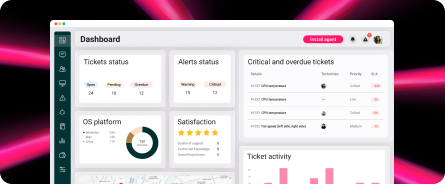
Atera’s admin dashboard view
Atera offers an intuitive UI design for IT departments right out of the gate, as well as a powerful PSA tool for MSPs to provide customers with help desk, billing, and reporting systems.
Comparatively, Microsoft Intune is primarily known for its intuitive interface once you get familiar with using the software. In other words, it can feel confusing and clunky at first. Users on Capterra mention that documentation isn’t being kept up to date, and the support experience isn’t responsive at all.
Microsoft Intune isn’t really suitable for MSPs because there isn’t a unified dashboard view for multiple accounts. This is something users constantly discuss on platforms like Reddit:

Pricing and value for money
Unlike most RMM pricing plans, Atera has transparent pay-per-technician pricing, where you can manage unlimited endpoints for a fixed cost. You know exactly what you’re paying for, and there aren’t any surprise fees.
Below are Atera’s pricing plans laid out:
Atera pricing for IT departments:
- Professional: $149 per month, per technician
- Expert: $189 per month, per technician
- Master: $219 per month, per technician
- Enterprise: Custom quotation, contact sales to get the pricing
- Pro: $129 per month, per technician
- Growth: $179 per month, per technician
- Power: $209 per month, per technician
- Superpower (Enterprise): Custom quotation, contact sales to get the pricing
In comparison, Microsoft Intune charges customers based on pay-per-device and user, meaning the price can increase quickly if you manage dozens of devices. This is yet another reason that Microsoft Intune is not always the best option for companies looking to grow and scale while keeping themselves lean.
Customer reviews and rating
How does Atera compare with Intune based on actual user reviews? According to the G2 comparison, Atera beats Intune in nearly every category:

You can access the full G2 comparison here.
Atera’s G2 Rating: 4.6 out of 5.0 stars (830+ reviews)
Microsoft Intune G2 Rating: 4.5 out of 5.0 stars (210+ reviews)
What Atera users are saying on G2:
- “Atera is a powerful RMM that we’ve integrated into our IT operations for managing endpoints, like computers, servers, and mobile phones,” a G2 user says.
- “Atera’s AI agents are constantly improving and offer helpful scripts. The platform is constantly developed, with new features coming out,” a G2 user says.
Atera’s Capterra Rating: 4.6 out of 5.0 stars (430+ reviews)
Microsoft Intune Capterra Rating: 4.5 out of 5.0 stars (38+ reviews)
What Atera users are saying on Capterra:
- “Atera’s Copilot and automated patch management have improved our efficiency. I’ve used Atera for 3 years and have seen tremendous growth in the service delivery,” a Capterra user says.
- “Atera is being used as an all-in-one RMM for centralized IT management, remote support, and proactive monitoring. It helps us solve several issues, like system downtime,” a Capterra user says.
2. ManageEngine Endpoint Central

ManageEngine Endpoint Central is an endpoint management solution for desktops, laptops, servers, mobile devices, and tablets. With it, IT professionals can manage patches and IT assets, run remote troubleshooting, and detect and remediate vulnerabilities through threat detection.
Endpoint Central is mainly for mobile device management, but it can be integrated with other ManageEngine products, such as RMM Central, for remote monitoring and management functionality.
G2 Rating: 4.4 out of 5.0 (880+ reviews)
Capterra Rating: 4.6 out of 5.0 (970+ reviews)
ManageEngine Endpoint Central Pricing:
- Professional: Starts at $104 for 50 endpoints
- Enterprise: Starts at $124 for 50 endpoints
- UEM: Starts at $139 for 50 endpoints
- Security: Starts at $205 for 50 endpoints
3. N-able

N-able helps IT organizations to monitor, manage, and secure their networks, servers, and endpoints remotely. One of its main products, N-sight RMM, provides endpoint management, remote access, help desk and ticketing, reporting, and billing capabilities.
Like Microsoft Intune, N-able charges its customers based on the number of devices they manage. N-able is suitable for MSPs and IT departments, but it can be very costly if you have dozens of devices to manage.
G2 Rating: 4.3 out of 5.0 (300+ reviews)
Capterra Rating: 4.3 out of 5.0 (150+ reviews)
N-sight Pricing:
- N-sight doesn’t make the pricing public, but it’s based on the number of endpoints you manage. You need to “Contact a specialist” from their website to receive the pricing.
4. Kaseya

Kaseya provides a suite of products that help IT professionals streamline their operations and automate manual tasks. One of Kaseya’s core products, Kaseya VSA, offers RMM, mobile device management, patch management, reporting, and billing capabilities.
With Kaseya VSA, you can manage Windows, Linux, and macOS devices, all from a single interface. You can set up automated workflows for solving device issues and deploying patches.
G2 Rating: 4.0 out of 5.0 (300+ reviews)
Capterra Rating: 4.1 out of 5.0 (200+ reviews)
Kaseya VSA Pricing:
- Kaseya doesn’t make its pricing plans public. To get it, contact their sales team.
5. ConnectWise Automate

ConnectWise Automate provides centralized management and security for devices, endpoints, and servers. It also monitors and automates IT troubleshooting. It’s an especially popular Intune alternative amongst enterprises that need advanced capabilities.
Even though ConnectWise offers robust functionality, many customers on G2 report that the software has a steep learning curve. The main reasons for this were ConnectWise’s outdated interface and its high customization capabilities, which made it difficult to find the right tools.
G2 Rating: 4.1 out of 5.0 (130+ reviews)
Capterra Rating: 4.2 out of 5.0 (135+ reviews)
ConnectWise Automate Pricing:
- The pricing is pay-per-device. To get the pricing for your organization, you need to request a quotation from ConnectWise’s team
6. Datto RMM

Datto RMM is a cloud-based IT management platform that provides remote monitoring and management, patch management, remote access, and reporting functionalities. With it, users can monitor the health, performance, and security status of Windows, macOS, and Linux devices.
Datto RMM can also be integrated with Datto’s other product, Autotask PSA if you need PSA functionality.
G2 Rating: 4.5 out of 5 stars (600+ reviews)
Capterra Rating: 4.3 out of 5 stars (30+ reviews)
Datto RMM Pricing:
- Datto RMM’s pricing is pay-per-device, and it’s not publicly listed. However, Reddit users estimate the pricing is $2.50 per endpoint and $100 per user for Autotask PSA.
7. Jamf Pro

Jamf is a mobile device management solution for Macs, iPads, iPhones, and other Apple devices. It’s a unique software in that it is entirely focused on the Apple ecosystem. One of its advantages is integration with Apple Business Manager, which makes it easy to configure Apple devices from one place.
Jamf Pro is a suitable alternative to Intune for mobile device management within the Apple ecosystem. It doesn’t support Windows or Linux devices.
G2 Rating: 4.8 out of 5.0 stars (1,900+ reviews)
Capterra Rating: 4.7 out of 5.0 stars (530+ reviews)
Jamf Pricing:
- Jamf Now: Starts at $4 per device, per month
- Jamf Business: Starts at $15 per user, per month
- Jamf Enterprise: Custom quotation
8. Ivanti Endpoint Manager

Ivanti provides a solution for managing and securing Android, iOS, Windows, Mac, Linux, and IoT devices. Although device management is one of Ivanti’s main capabilities, it also has features like asset discovery, patch management, PSA, remote access, and more.
If you’re an enterprise searching for these features, Ivanti can be a suitable alternative to Microsoft Intune. Ivanti is capable of a lot of this, but some G2 customers feel that the software is hugely complicated and that the company will take a long time to activate new features.
G2 Rating: 4.2 out of 5.0 stars (130+ reviews)
Capterra Rating: 3.0 out of 5.0 stars (1 review)
Ivanti Endpoint Manager Pricing:
- Custom pricing. To get the pricing, fill out your details on Ivanti’s website.
9. Pulseway

Pulseway allows IT teams and MSPs to monitor, manage, and control their IT infrastructure remotely. Due to its focus on remote monitoring and management, it is a viable alternative to Intune for those needs. One of Pulseway’s strengths is its mobile app, which helps in monitoring and managing IT systems remotely from a smartphone or tablet.
Pulseway offers transparent pay-per-endpoint pricing, although it charges additional costs for features like third-party patch management, ransomware, and endpoint protection.
G2 Rating: 4.6 out of 5.0 (110+ reviews)
Capterra Rating: 4.7 out of 5.0 (305+ reviews)
Pulseway Pricing:
- Basic: Custom pricing available. Visit their website to find out what the price is based on your own situation.
10. NinjaOne

NinjaOne provides IT professionals with RMM, endpoint and patch management, and remote access capabilities. Unlike Microsoft Intune, MSPs can also use NinjaOne to manage their clients’ devices, servers, and other endpoints. MSPs can access a ticketing system for categorizing and managing support requests.
Similar to many NinjaOne alternatives, NinjaOne’s pricing is based on pay-per-endpoint, meaning you pay for the number of devices you manage.
G2 Rating: 4.7 out of 5.0 (2,000+ reviews)
Capterra Rating: 4.8 out of 5.0 (220+ reviews)
NinjaOne Pricing:
- NinjaOne requires you to contact their sales team to get the pricing. To do this, you can fill out a form on their website.
11. Addigy

Addigy offers cloud-based mobile device management for macOS, iOS, iPadOS, and tvOS devices. Similar to Jamf, it’s entirely focused on the Apple ecosystem and integrates similarly to Apple Business Manager.
Addigy provides an alternative to Intune for Apple ecosystem users, but it does not support Windows or Linux.
G2 Rating: 4.5 out of 5.0 stars (200+ reviews)
Capterra Rating: 4.6 out of 5.0 stars (10+ reviews)
Addigy Pricing:
- Standard: Up to $6 per device
- Premium: Up to $8 per device
- Addigy Premium for MSPs: Up to $6 per device
Choosing the right Microsoft Intune alternative
As we previously discussed, Microsoft Intune is an MDM solution, which is different from an RMM solution, such as Atera. The capabilities of RMM solutions are much broader, and in many cases, an RMM can replace an MDM, but not the other way around.
For this reason, a solid RMM solution is the best option for most IT departments to manage all their IT needs within one platform.
Atera equips IT teams with top-tier remote monitoring and management, automated patch management, advanced reporting and analytics, and MDM integrations, accompanied by the industry’s only true Agentic AI technology.
Interested in learning more? Get started with Atera’s 30-day free trial, or contact our sales team to discuss your needs further.
Now that we’ve reviewed the alternatives, let’s continue with a quick overview of Microsoft Intune’s limitations and strengths.
What is Microsoft Intune?
Microsoft Intune is an endpoint management tool that lets users manage and secure their organization’s devices, applications, and data. Intune is a part of the Microsoft product family and integrates with other Microsoft products, such as Microsoft 365, SCCM, and Endpoint Analytics.
Intune is mainly used for managing Windows-based devices. It’s worth noting that if you have a lot of non-Windows devices and users in your IT environment (which is very common in today’s IT environments), it might not be the best solution.
We always recommend looking for an IT management tool that is compatible with Windows, Mac, iOS, Linux, and more.
Why look for a Microsoft Intune alternative?
As part of writing this article, we didn’t want to list any speculative limitations of Intune. We actually wanted to see what users find limiting about the platform.
G2, Reddit, Gartner, and Capterra reviews revealed that the main limitations of Microsoft Intune are:
- Poor compatibility with non-Windows devices
- Additional costs for “basic features”
- Lack of key IT management features
- Difficulties using the Intune portal
Let’s look at each limitation in more detail.
1. Poor compatibility with non-Windows devices
This was a frequent complaint from Intune users.
Microsoft claims that Intune makes managing Apple and Linux devices easy, but many user reviews indicate otherwise. For example, see what these Reddit users discussed:

Another G2 user said this:

The main point of the above reviewer is that managing Apple devices takes a lot more configuration than Windows devices.
Another Intune user on G2 agreed to this and said, “There are limitations in supporting non-Microsoft environments.”

If you have a multi-OS environment, this can be a serious disadvantage as your configuration process is more lengthy each time you add new Apple devices.
2. Additional costs for “basic features”
Intune’s base pricing plans are laid out on their website, but users report expensive add-on costs and hard time figuring out what they’re paying for.
For example, see what these Reddit users said:

Plus, features like device remediation require you to have an enterprise plan on Microsoft Intune, which is a real barrier for many organizations. This is what Intune users said about it:

This makes Intune out of reach for most SMBs, and as the users above discuss, it can even be extremely costly for enterprises.
3. Lack of key IT management features
Intune is mainly focused on offering MDM capabilities and, unfortunately, lacks other key IT management features, such as RMM. And the truth is, RMM can often replace an MDM, but not the other way around.
Related to this, see what this Intune user on Reddit said:

This means Intune users need to invest in third-party tools for features like RMM, patch management, or remote access. The obvious downside is increased subscription costs.
4. Using Intune can be difficult
When users are asked to describe their Intune onboarding experience and the interface’s intuitiveness, the responses are mixed.
For example, see what this Reddit user said:

Reviewers like the above say Intune is not user-friendly, the feature set is not consistent, and it’s not possible to create folders, to name a few.
Arguably, all of these factors make onboarding more difficult, and new technicians have a harder time managing their IT environments.
What are Microsoft Intune’s specializations?
Intune has its limitations, but it also has notable strengths. Users especially like its ability to streamline device management and integrations with other Microsoft products.
This is what users said:
1. Centralized device management
The main use case of Microsoft Intune is managing all of your devices from a unified platform. Users appreciate this, saying, “You get an overview of all device information in one place.”

2. Integration with other Microsoft products
Microsoft Intune is part of the Microsoft product family and integrates well with its other products.
As this G2 user said, if you’re already invested in other Microsoft 365 products, Intune can be a good addition, given its native compatibility.
The pros and cons of Microsoft Intune: An overview
To conclude the two previous sections, here are the pros and cons of Microsoft Intune.
The pros:
- You can easily manage all of your devices and access key information from one unified place
- Intune integrates natively with other Microsoft products
The cons:
- Poor compatibility with non-Windows devices
- Additional costs for key IT management features
- Lack of features, such as RMM software or patch management for all OS
- The onboarding process of Intune is known to be difficult
Frequently Asked Questions
Related Articles
The 7 Best Patch My PC Alternatives in 2026
Discover the best Patch My PC alternatives. Compare them across pricing, features, AI, and user reviews. See which option works best for your organization.
Read now
The 7 Best Rev.io Alternatives Your IT Team Can Use In 2026
Learn about the best Rev.io alternatives that modern IT teams use. See how they compare across features, pricing, user reviews, and AI.
Read now
Top 7 Aisera Alternatives for 2026
Learn about the best Aisera alternatives. See how they differ across features, Agentic AI, pricing, and user reviews.
Read now
7 Best Autotask PSA Alternatives for 2026
Find out the best Datto Autotask PSA alternatives. See how they compare across features, pricing, user reviews, and Agentic AI.
Read nowEndless IT possibilities
Boost your productivity with Atera’s intuitive, centralized all-in-one platform