Table of contents
Table of contents
- Atera vs. PDQ: An overview
- What makes Atera the best PDQ alternative?
Generate summary with AI

If you’re searching for a tool to manage your organization’s device fleet, you’ve probably heard of both Atera and PDQ.
Both Atera and PDQ share similar endpoint management features, such as RMM, patch management, and remote control. While these core features are the same, one of Atera’s standout features is its Agentic AI technology, which helps organizations eliminate up to 40% of their workload instantly. But the differences don’t end here.
If you’re up for a detailed Atera vs. PDQ review, this article is for you. We’ve compared the two across pricing, features, Agentic AI, interface, support, and user feedback.
Key Takeaways:
- PDQ offers automation, but Atera stands out with its Agentic AI technology. Atera’s Robin can resolve 80% of tier-1 issues autonomously
- PDQ’s per-device pricing can work for small IT environments, but Atera’s unique per-technician model is more predictable as endpoint counts grow
- Atera offers 75+ native integrations for its platform and Robin, while PDQ relies entirely on API-based integrations
- Atera offers reliable 24/7 live chat and email support, whereas PDQ support is primarily via ticket submission
- PDQ can work for small-scale endpoint management, but Atera is the best overall choice for teams that want an all-in-one IT management platform with Agentic AI, predictable per-technician pricing, and broader capabilities as they scale
Atera vs. PDQ: An overview
To begin, here’s a brief overview of Atera vs. PDQ:
| Atera Features | PDQ Features | ||
| – Autonomous IT tool with built-in RMM, remote access, network discovery, and documentation – Manage Windows, macOS, and Linux workstations, servers, and other network devices with Atera’s RMM – Robin for managing tier-1 support fully autonomously – AI Copilot for AI-powered troubleshooting, scripting, ticketing, and more – Atera’s ticketing system for summarizing and resolving issues instantly – Scripting engine powered by AI Copilot – Asset management to track the lifecycle of IT assets – Patch management to keep Windows, macOS, Linux, and third-party apps up-to-date – PSA for MSPs to track contracts, billing, SLAs, and more | – Windows & macOS endpoint management – Remote control for accessing devices remotely – Patch management for Windows devices – Alerting system for staying on top of potential vulnerabilities – Asset management for tracking hardware and software – Software inventory management | ||
| Customer support | Customer support | ||
| – 24/7 email and live chat support for all customers – An extensive knowledge base, IT community, webinars, and tutorials available | – Support available through a ticket form on PDQ’s website – Community discord and documentation available | ||
| Integrations | Integrations | ||
| – Integrations with 25+ cybersecurity, automation, backup, remote access, network monitoring software, and other third-party tools – Integrations with 50+ third-party tools for Robin – Access to 5,000+ apps through Zapier | – Custom integrations available through PDQ’s API – Entra ID (Azure AD) integration | ||
| Pricing | Pricing | ||
| – Transparent pay-per-technician pricing, starting from $129/month – 30-day free trial available | – Per-device pricing starting from $12/device/year – 14-day free trial available |
#1: Features and capabilities
Let’s start with the features of Atera and PDQ. Both platforms offer the same core RMM capabilities, including real-time monitoring and alerting, remote control, patch management, and asset management.
Of the two platforms, only Atera extends its features to ticketing, PSA, and Agentic AI. PDQ also only offers support for Windows environments, lacking Mac and Linux patching and troubleshooting.
The lack of multi-OS support is something many PDQ customers find missing:

Atera’s leading patch management tool and RMM not only support Windows, but also Mac and Linux devices.
With PDQ, customers on G2 also report limitations within the scripting and automation capabilities:

Atera not only offers full-fledged scripting and automation, but our scripting engine is powered by AI Copilot. To create a script, you simply need to type in a simple prompt, and our AI engine will create it for you.
Copilot’s AI script generator is something Atera customers on G2 truly love about the platform:

In terms of features, what makes Atera a superior option is its support for multi-OS, Agentic AI for reducing repetitive tasks, and all-in-one functionality to eliminate the need for extra third-party tools.
#2: Agentic AI development
IT environment’s complexity keeps growing, and efficiency is becoming the name of the game. Agentic AI helps make that possible.
Of Atera and PDQ, only Atera has implemented Agentic AI technology into its platform. In fact, Atera offers the world’s first Agentic AI platform for IT management that helps organizations move from automated to fully autonomous IT.
Atera’s Robin handles 80% of your first-tier support by installing software, troubleshooting devices, resolving technical issues, and generating setup instructions.
Unlike most general AI chatbots that only interact with users, Robin is capable of solving real-world IT issues.

For more complex tasks, Robin is capable of automatically escalating them to technicians, which is where Atera’s AI Copilot comes in handy. AI Copilot helps technicians run health checks, execute actions, generate scripts, summarize tickets, and much more.
For enterprises with large device fleets, Copilot also helps in filtering out the right ones through simple prompts, such as:
- “Show me all devices with low disk space.”
- “Find endpoints missing critical OS patches.”
- “Identify machines with high CPU usage.”
- “Find PCs that have new security patches.”

Doing similar filtering tasks with PDQ is still a highly manual process.
Atera’s AI agents are truly advantageous for enterprises dealing with increased ticket volumes and staff shortages.
And we’re not the only ones praising our AI agents. G2 selected Atera as the #1 best AIOps tool for 2026. Atera Robin also landed the number one spot on SourceForge’s comparison of the best AIOps tools.
The Agentic AI technology truly solidifies Atera as the best PDQ enterprise alternative.
#3: Pricing and value for money
Pricing plays an important role in selecting an IT management solution. Atera and PDQ offer two different types of endpoint management and RMM pricing plan structures.
Another factor making Atera truly a superior PDQ alternative is its per-technician pricing, which allows you to manage unlimited endpoints for a fixed monthly/annual cost.

Atera’s IT department pricing
With PDQ, you pay for the number of endpoints you manage. For each new endpoint, the monthly/annual cost increases. For growing organizations, PDQ’s cost can quickly skyrocket, and budgeting can be difficult.
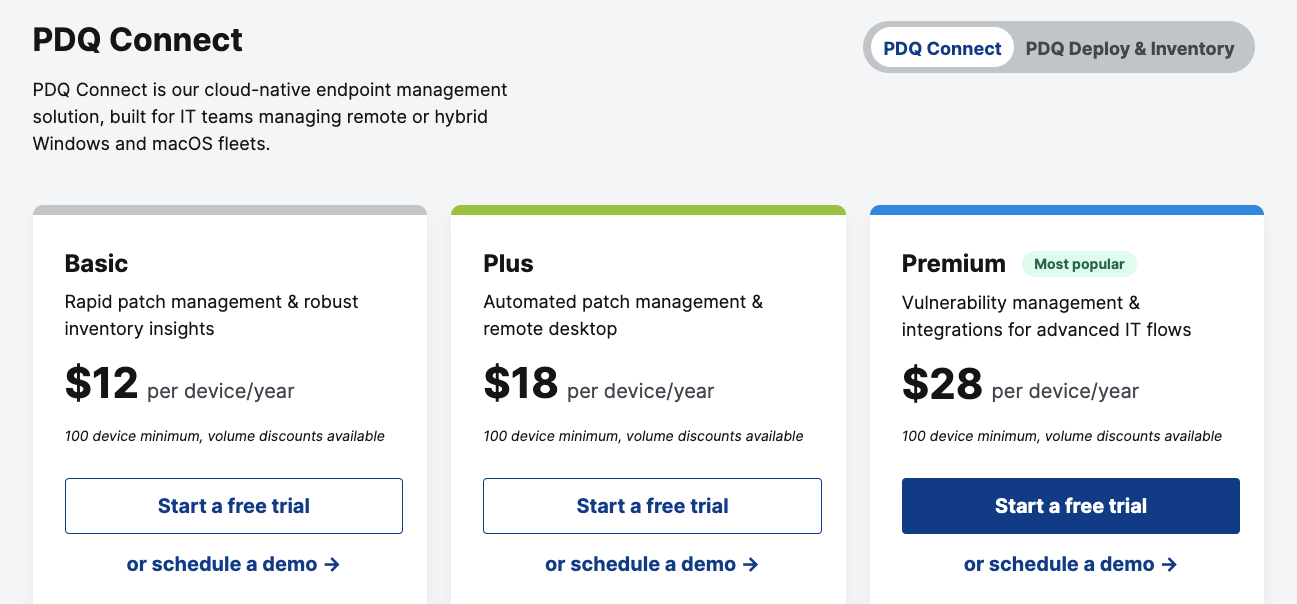
PDQ’s pricing
For example, the cost for managing 1000 devices would already be $28,000/year.
With Atera, you can truly manage unlimited devices and only pay for the number of technicians, starting from $149/month.
Atera’s pricing structure is something its customers love. One G2 user described it and said, “The pricing model of Atera is much more advantageous as it is based on agents rather than endpoints, which makes it cost-effective.”
#4: User interface and usability
It’s also important to compare the user interfaces of Atera vs. PDQ. After all, a platform’s day-to-day experience matters as much as its feature set. The easier it is to navigate, the more efficiently your IT team can work.
Here’s a look at PDQ’s admin dashboard:

PDQ Connect interface (Source)
In comparison, here’s a look at Atera’s admin dashboard:

We truly believe that Atera offers a more intuitive user interface. Our dashboards are fully customizable to your liking, and we’ve made the onboarding process easy for both startups and enterprises. If you face any issues, you can always be in touch with our 24/7 support.
One G2 user described Atera’s admin dashboard and said, “The dashboard is easy to work with. I can monitor all devices, run scripts, and manage tickets without switching between multiple screens.”

#5: Customer support and community
Atera and PDQ employ different types of support options. For Atera, 24/7 live chat support is available for all users, and enterprises get access to a dedicated onboarding manager.
For PDQ, support is available by submitting a ticket on PDQ’s website, but their team hasn’t specified how long it takes to get a response. But reviews give some clues. One Reddit user said that PDQ’s support response times have been going downhill lately:

At Atera, support is our number one priority. We understand that IT teams need support they can count on. If something goes wrong, you get expert help instantly, and your IT environment stays running at all times.
One G2 user described Atera’s support and said, “Their chat support answered immediately, and within just a couple of minutes, the issues were fixed.”

Other factors making Atera a leading PDQ alternative include its active IT community, extensive knowledge base, video tutorials, and monthly webinars.
#6: User feedback and reviews
On G2 alone, Atera has received nearly 1,000 reviews with an average rating of 4.6 out of 5.0 stars, while PDQ has 120+ reviews.
One Atera user on G2 mentioned using the Agentic AI technology, which has helped their team remove nearly 50% of their level 1 support tickets:

Another user praised Atera’s leading capabilities for monitoring an IT infrastructure:

One G2 user liked Atera’s interfaces and said, “The interface is clean, which makes it easy to monitor devices, run scripts, manage tickets, and support clients. You don’t need to be a highly technical person to navigate it.”

For PDQ, most of its reviews revolve around its endpoint management and remote support capabilities, although it has received criticism for lacking more advanced features.

For example, this is what one G2 user said:

PDQ offers two products, one for cloud-based environments and one for on-premise. Some users on G2 say that some of the on-premise features aren’t yet available on the cloud-based version, such as PowerShell scanning.
At Atera, all of our effort is in developing our cloud-based platform, which is how most organizations prefer operating in today’s world.
What makes Atera the best PDQ alternative?
Atera has several advantages over PDQ that make it truly the leading PDQ alternative. Atera’s four advantages over PDQ are:
- Multi-OS support: PDQ only supports Windows devices, which is a huge drawback for organizations with Mac and Linux devices. In comparison, Atera is superior for organizations with multi OS environments (Windows, Mac, and Linux), as it offers support for all of these.
- Per-technician pricing: Unlike PDQ, Atera lets you manage unlimited devices/endpoints for a fixed monthly cost. No need for complex device-based pricing plans; simply pay for the number of technicians using the platform.
- Agentic AI technology: Atera is the world’s first autonomous IT platform, helping organizations in removing manual and repetitive tasks. Device management tasks that are still highly manual with PDQ (e.g., generating scripts or troubleshooting devices) can be done partially, or even fully autonomously with Atera.
- 24/7 customer support: Of Atera and PDQ, only Atera offers 24/7 live chat and email support for all users. With PDQ, the only way to contact support is by opening a ticket. With Atera, enterprises also have access to a dedicated customer success manager.
Ready to get started? Sign up for Atera’s 30-day free trial today to transfer your IT operations from automated to fully autonomous.
Frequently Asked Questions
Related Articles
Atera vs. Deel IT: A comparison for IT teams
Find out about the key differences of Atera vs. Deel IT. We’ve compared the two across features, Agentic AI, pricing, support, and interfaces.
Read now
Atera vs. Gorelo: A guide for IT decision makers
See Atera vs. Gorelo compared across key categories, like Agentic AI, features, pricing, user interface, and customer support.
Read now
Atera vs. Rev.io: Full look at the differences for IT teams
See Atera vs. Rev.io compared on pricing, Agentic AI, user interface, and features. Find out which one is the better option for your IT team.
Read now
Atera vs. Tanium: A comparison for IT teams in 2026
See Atera vs. Tanium compared: two autonomous endpoint management contenders. Learn how they differ in AI, platform features, and pricing.
Read nowEndless IT possibilities
Boost your productivity with Atera’s intuitive, centralized all-in-one platform