Table of contents
Generate summary with AI

In 2025, we expect to see major agentic AI disruption across a variety of different industries. Agentic AI is able to autonomously learn, adapt, make independent decisions, and take actions based on context and data in real time. A host of agentic AI trends and predictions point to this year being a tipping point for the adoption and implementation of autonomous AI agents.
But don’t just take our word for it – experts like Gartner predict that by 2028, more than one-third of enterprise software applications will employ agentic AI models. And according to Forrester, agentic AI is poised to be one of the top 10 emerging technologies for the year. Let’s take a look at the ways in which AI industry disruption is going to be kick-started, specifically by agentic AI this year.
#1: IT and managed services
In the IT industry, IT pros are embracing AI-powered solutions to automate mundane, repetitive work. Agentic AI frameworks can streamline processes like ticketing, patching, monitoring, self-healing, and even proactive support.
For example, consider Atera’s AI Copilot tool, which has capabilities like remote session summarization, command line generation, on-demand insights, real-time data analysis, predictive analytics, troubleshooting, knowledge base connection, script writing, and so much more.
Users have seen unparalleled leaps in efficiency and productivity, including 10X faster ticket resolution and ticket volume reduction rates. Leeds United Football Club, for instance, was able to get out from under a ticketing overload by reducing ticket volume by 35% with AI Copilot.
“How?”, you might ask? These advanced AI tools were able to empower many end users to resolve common issues without needing to elevate the ticket to a human technician. IT pros can then shift into more strategic roles, leaving the busy work to AI agents.

Source: Atera
#2: Healthcare
Healthcare is poised to be one of the key industries disrupted by agentic AI in 2025. AI is already being implemented in this industry, and new developments in agentic AI will support diagnostics, patient scheduling, data analysis, and personalized care. AI tools will ease the pressure on clinical staff with healthcare IT automations that reduce paperwork and mundane tasks that get in the way of lifesaving care.
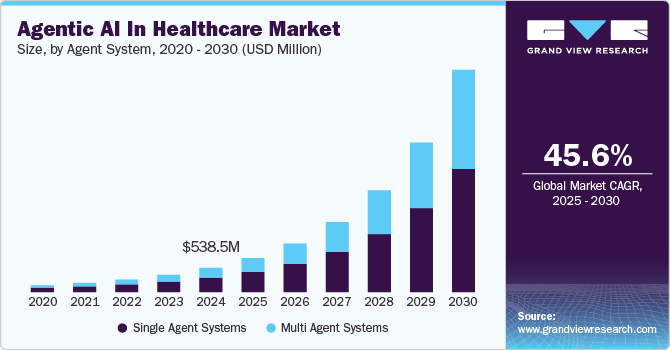
Of course, there are also ethical considerations around autonomous decision-making when it comes to AI in healthcare. Introducing company-specific frameworks for ethical AI usage, as well as complying with broader industry standards and continuing to hold open dialogues about these issues, is important for ensuring the success of AI in healthcare. As you can see from the graphic below, the market value of AI in healthcare is set to boom over the next five years.
Source: Grand View Research
#3: Finance and banking
In the finance and banking industry, autonomous AI agents are expected to play important roles in fraud detection, compliance checks, customer support, and trading. With the integration of these tools, we expect to see a major impact when it comes to the speed and accuracy of financial operations. The World Economic Forum also notes in a 2024 article that agentic AI has the potential to boost inclusivity and access for financial services in underserved communities.
While these innovations offer efficiency and access, the World Economic Forum also raised concerns about labor market disruption, privacy violations, market volatility, and governance. Effective agentic AI implementation in the finance and banking sphere will necessitate robust human oversight as well as the employment of rigid ethical frameworks.
#4: Customer service
AI business disruption is expected to be especially pronounced in the customer service industry. AI agents can resolve tickets, handle multi-channel queries, and learn from interactions to improve their work on an ongoing basis. With faster and more effective resolutions powered by AI, customer support technicians won’t get so bogged down, reducing support costs and increasing customer satisfaction scores.
With integrations with CRMs and ITSM tools, customer service powered by agentic AI will likely boom in 2025, making headway in many of the other industries included on this list as well. A great example? Atera’s AI help desk solution, which helps speed up response times, prioritize customer support requests, and minimize the costs of manual IT labor.
#5: Marketing and sales
In the marketing and sales space, agentic AI is set to allow for unprecedented personalized and autonomous campaign management. These tools are likely to allow for real-time A/B testing, dynamic content generation, and lead scoring that will help AI in marketing and sales go from assistant to autonomous decision-maker.
The Wall Street Journal has even described agentic AI as the “next frontier in autonomous marketing,” citing abilities like automated customer profile creation, asset development, email personalization, and more.
#6: Logistics and supply chain
Agentic AI disruption is coming in hot to the logistics and supply chain industry. Self-directed agents will be able to manage inventory, routing, procurement, forecasting, and more.
Agentic AI tools can improve the agility and resilience of the logistics and supply chain industry through real-time data analysis and ongoing model improvement as these programs learn and become better and better over time.
Agentic AI’s ability to take autonomous action is what sets it apart from prior AI models. For example, previous AI frameworks might be able to detect a delay and notify a logistics manager to intervene. Agentic AI tools can remove the human intervention step, automatically rerouting shipments, notifying customers, and adjusting schedules.
#7: Education and eLearning
In the world of education and online learning, agentic AI disruption is set to make major changes in 2025. Magazines like EdTech and others have explored the possibility of personalized learning journeys guided by AI agents.
With the predictive analytics and data processing abilities of agentic AI, we may see real-time curriculum adjustments in line with engagement tracking and progress analysis. Teachers can hone their roles as facilitators rather than content creators, focusing on providing individualized attention to their students with the support of AI.

Source: Medium
#8: Legal services
AI is already disrupting the legal industry, but agentic AI is taking things to the next level by conducting legal research, case summarization, contract analysis, and even drafting early-stage legal documents.
Law firms are using AI agents to triage client inquiries, search legal databases, and flag compliance risks. Thomson Reuters has emphasized the importance of fostering technical skills in the next generation of lawyers, who will likely be working in tandem with AI.
#9: Manufacturing and industrial automation
Industrial automation and manufacturing are certain to be targets for agentic AI disruption in 2025. These industries are widely understood to suffer from dated technology and are slowed down by manual labor and restrictive costs. But with the dawn of agentic AI, we expect change. AI agents can now oversee end-to-end production lines, manage predictive maintenance, and make real-time adjustments to machinery settings.
With integration with IoT (Internet of Things) and robotics, highly autonomous factories are on the horizon. In January 2025, the World Economic Forum suggested that autonomous AI agents will push the boundaries of manufacturing as we know it. H
uman roles in these industries will transition from hands-on builders and operators to more strategic positions that are centered around oversight, creativity, and decision-making.
#10: Human resources and recruitment
The world of HR and recruitment is ready for an overhaul – and agentic AI is exactly what the doctor ordered. From screening candidates to scheduling interviews and onboarding, agentic AI tools are making HR faster and more strategic. Agents can also monitor engagement and even suggest personalized retention strategies for employees.
AI agents could perform a number of different automated tasks, including autonomously generating job descriptions and listings, sourcing candidates, screening resumes, ranking candidates, and even scheduling interviews. With agentic AI, the need for human intervention between each of these steps disappears.
Of course, HR presents an especially prudent example of the importance of adhering to ethical standards of AI usage. With more reliance on agentic AI, it’s crucial to work toward eliminating bias in training data and ensuring that agentic AI models do not disadvantage any individuals or groups due to faulty training data.

Source: Science Direct
#11: Real estate and property management
In real estate and property management, agentic AI disruption is right around the corner. Agentic AI tools can handle tenant inquiries, schedule viewings, generate lease agreements, and even analyze investment data.
Similar to some of the agentic AI functions in the finance and banking space, AI agents can autonomously optimize pricing based on market trends and availability. Real estate is about to change for the better with the dawn of agentic AI.
#12: Retail and eCommerce
eCommerce is set to be one of the biggest industries disrupted by agentic AI in 2025. Why? The incredible possibilities of customer personalization at scale can now be executed by agentic AI. These autonomous agents can also manage pricing strategies and inventory replenishment. AI agents are working around the clock, meaning they can run campaigns, predict trends, and test website flows without manual input. New launches like OpenAI’s “Operator” are just the beginning of a new age of eCommerce and online retail.
How to prepare for the disruption of Agentic AI
Are you ready for the agentic AI disruption coming in 2025? In order to stay ahead of the curve, remaining in the loop about agentic AI developments is essential. It’s time to start looking for ways to integrate agentic AI into your company in order to boost productivity and enhance customer satisfaction.
Where to start? We suggest beginning by auditing workflows, starting with low-risk use cases, and educating teams about AI. It’s also important to build infrastructure that can support autonomous agents at scale.
The key factor in successfully adopting agentic AI? A strategically planned approach is going to get you much farther than reactive, last-minute adoption. With an easy-to-learn agentic AI tool like Atera’s AI-powered ITSM system, you can smoothly bring agentic AI into your organization’s IT environment.
You’ll empower your technicians to reduce manual labor and focus on more critical, strategic tasks. You’ll improve your cybersecurity posture, reduce ticket resolution times, and bring your company into the 21st century. What’s not to love?
Harness the transformative power of agentic AI
This year is set to be a breakthrough year for agentic AI, which is why you need to make sure that your organization is ready for the takeover. Atera is pioneering the shift from automation to autonomous IT. With our AI-powered IT management tools, IT teams can offload repetitive tasks, resolve issues faster, ensure better service, and focus on strategy. We’re committed to meeting the highest security and compliance standards and following responsible AI frameworks so that you can trust in our tools.
Atera’s AI-powered IT platform has already been proven to transform ITSM operations. Now, you can see for yourself how automation can transform your operations with a free 30-day trial, no credit card required.Not convinced? Check out how some of our customers are using Atera to transform their IT operations.
Related Articles

The AI Startups Turning South Korea Into a Global Innovation Powerhouse
South Korea is rapidly emerging as one of the world’s most dynamic AI innovation hubs, fueled by strong government investment, advanced semiconductor manufacturing, and a growing startup ecosystem. From healthcare diagnostics and service robotics to generative AI and next-generation chips, a new wave of companies is shaping how artificial intelligence is applied across industries. This article highlights six South Korean AI companies gaining worldwide attention and the factors driving the country’s expanding role in the global AI economy.
Read now
The Japanese AI Companies That Could Change Global Tech
Japan is rapidly emerging as a major hub for artificial intelligence innovation, with startups applying AI across manufacturing, healthcare, logistics, and enterprise automation. Companies like Preferred Networks, ABEJA, and ExaWizards are using machine learning and data intelligence to solve real-world business challenges. As labor shortages, robotics expertise, and government investment accelerate adoption, Japan’s AI sector offers valuable insights into the future of global technology. Here are eight Japanese AI companies gaining attention, along with some reasons business leaders should be watching them.
Read now
The Chinese AI Surge That’s Redefining Global Competition
China’s AI sector has quickly evolved into one of the most influential forces in global innovation. With more than 5,300 companies operating across a wide range of industries, China is helping redefine what large-scale AI deployment looks like. These rising innovators are accelerating AI commercialization, compressing innovation cycles, and raising the competitive bar for businesses worldwide.
Read now
The French AI Boom You Can’t Afford to Ignore in 2026
France has rapidly become one of Europe’s most influential AI growth markets, backed by major public investment and a surge in enterprise adoption. From generative AI and drug discovery to insurance automation and defense systems, French innovators are building globally competitive solutions across industries. Here’s a closer look at the companies helping position France at the center of the next wave of artificial intelligence.
Read nowEndless IT possibilities
Boost your productivity with Atera’s intuitive, centralized all-in-one platform