Generate summary with AI

For these reasons, many IT teams (like probably yours) are looking for alternatives.
Fortunately, many modern solutions are available, offering better support for multi-platform environments, while being much easier to use, even in large IT environments.
To help you choose the best SCCM alternative, we have written this article. Below, we will review the 11 best SCCM alternatives, and then go through the main limitations of SCCM and its strengths
11 best SCCM alternatives
The best SCCM alternatives for 2026:
- Atera
- Action1
- Automox
- SolarWinds
- SysAid
- Ivanti
- N-central
- Syncro
- Acronis
- ManageEngine
- Kaseya
To select the alternatives, we compared the pricing, features, and customer reviews of each software. Below is a breakdown of each Microsoft SCCM alternative.
1. Atera

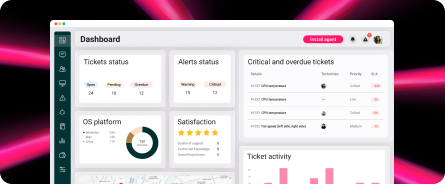
1. Key features: Both Atera and SCCM offer endpoint management capabilities for enterprises, but their approaches differ. While SCCM is an on-premise tool for Windows-based devices, Atera is a cloud-based IT management tool for Windows, macOS, and Linux devices. Atera’s all-in-one platform combines RMM software, patch management, remote access, network discovery, and Agentic AI technology into one, unified solution.
2: AI advancements: As of 2025, SCCM hasn’t added any AI tools to its platform, which could help users be more effective. Comparatively, Atera is transforming the IT landscape with its autonomous IT capabilities, powered by Robin and AI agents—a skilled digital workforce for IT.
Tasks you’d need to do manually with SCCM, such as troubleshooting technical issues or filtering out devices, Atera’s AI agents can handle automatically. This means 40% of your IT workload is automatically eliminated, and your technicians can focus on tasks that actually move the needle.
3. Pricing: Atera is known for its transparent pay-per-technician pricing model. This means you can manage unlimited devices for a fixed monthly cost, making scaling more cost-effective and predictable. SCCM’s pricing is based on the number of devices you have, and it has received some complaints for being expensive to use.
Atera customer reviews
Atera’s G2 Rating: 4.6 out of 5 stars (830+ reviews)
What Atera users are saying on G2:
- “Atera is an RMM tool, which has a lot of features, including monitoring of networks, such as networks, servers, and end-user devices,” a G2 user says.
- “I like Atera’s fair pricing, you pay for technicians but not for machines, so I can manage our company with a single license,” a G2 user says.
Atera’s Capterra Rating: 4.6 out of 5 stars (430+ reviews)
What Atera users are saying on Capterra:
- “Atera makes managing IT tasks a lot simpler. The setup was quick, the interface is friendly, and I can find what I need without any trouble,” a Capterra user says.
- “Our experience with Atera has been excellent. Its user-friendly UI and intuitive design have simplified task navigation for our staff,” a Capterra user says.
Atera pricing plans
Atera pricing plans for IT departments:
- Professional: $149 per month, per technician
- Expert: $189 per month, per technician
- Master: $219 per month, per technician
- Enterprise: Custom quotation; contact sales to get pricing
- Pro: $129 per month, per technician
- Growth: $179 per month, per technician
- Power: $209 per month, per technician
- Superpower (Enterprise): Custom quotation; contact sales to get pricing
2. Action1

Action1 is known as a patch management software for Windows, Linux, and Mac devices, as well as for third-party applications. It helps automate patching by scanning your network for missing updates and installing patches to multiple endpoints.
Action1 also has a simple endpoint management tool that proactively detects and mitigates threats and reduces IT disruptions. You can create a detailed asset inventory that highlights installed software and system configurations.
G2 Rating: 4.9 out of 5.0 (500+ reviews)
Capterra Rating: 4.9 out of 5.0 (200+ reviews)
Action1 Pricing:
- Custom quotation: To get pricing from Action1, you need to request a quote from their website.
3. Automox

Automox helps users to automate patching, configuration, and control for Windows, macOS, and Linux endpoints. Endpoints can be accessed through the remote troubleshooting feature, and the available reports provide insights into the state of your devices.
A standout feature of Automox compared with SCCM is its AI scripting capability. Similar to Atera’s AI scripting tool, users can generate custom scripts to fix issues like slow device performance or concurrent application crashes.
G2 Rating: 4.4 out of 5.0 stars (200+ reviews)
Capterra Rating: 4.7 out of 5.0 stars (140+ reviews)
Automox Pricing:
- Patch OS: $1 per endpoint per month for patch management
- Automate Essentials: Pricing is based on a custom quotation; please contact Automox for details
- Automate Enterprise: Based on custom quotation
4. SolarWinds Patch Manager

As the name suggests, SolarWinds Patch Manager is a patch management software for managing Microsoft and third-party applications. The key features include automated patching, compliance reporting, remote access, and automation.
While SolarWinds Observability lets you manage Mac, Linux, and Windows devices, SolarWinds’ patch management tool supports only Windows patching. This can be a drawback for IT teams with multi-OS environments.
G2 Rating: 4.0 out of 5.0 stars (50+ reviews)
Capterra Rating: 4.3 out of 5.0 stars (10+ reviews)
SolarWinds Patch Manager Pricing:
- Custom pricing: Pricing starts at $1,851. To find out the exact pricing, contact the SolarWinds sales team.
5. SysAid

Compared to SCCM, SysAid is a more ITSM-focused solution with features like helpdesk and ticketing, asset management, problem management, and change management. You can map all of your assets automatically and gain insights into asset health, usage, and risk. Despite focusing mainly on ITSM, it offers patch management for Windows and third-party applications.
SysAid might not be the best SCCM alternative for features like RMM and remote access, as they’re not available built-in.
G2 Rating: 4.5 out of 5.0 stars (720+ reviews)
Capterra Rating: 4.5 out of 5.0 stars (490+ reviews)
SysAid Pricing:
- Based on a custom quotation. Book a demo call with SysAid to receive pricing.
6. Ivanti Endpoint Manager

Ivanti Endpoint Manager is an endpoint management solution for monitoring and managing Windows, macOS, Linux, and IoT devices. The key features include automated device discovery, reporting, and user profile management.
For all of your devices, you can deploy the latest OS updates as well as third-party application patches. Using the remote access tool, you can connect to devices remotely for troubleshooting.
G2 Rating: 4.2 out of 5.0 stars (130+ reviews)
Capterra Rating: 3.0 out of 5.0 stars (1 review)
Ivanti Endpoint Manager Pricing:
- Custom pricing. To get the pricing, fill out your details on Ivanti’s website.
7. N-central Patch Management

N-central Patch Management is a software for patching Windows-based devices and third-party applications. You can set up patch policies for automating updates, defining approval rules, and scheduling deployments.
With N-central, you can also manage Mac and Linux devices, which is one advantage over SCCM. Expect the App Store, all Apple updates are available, and over 200 third-party applications, such as Java Flash, Chrome, Firefox, and Office.
G2 Rating: 4.4 out of 5.0 stars (500+ reviews)
Capterra Rating: 4.1 out of 5.0 stars (190+ reviews)
N-central Pricing:
- N-sight doesn’t make the pricing public, but it’s based on the number of endpoints you manage. You need to “Contact a specialist” from their website to receive the pricing.
8. Syncro

Syncro is an IT management solution for MSPs and IT departments. It offers real-time monitoring and alerting, scripting, remote access, IT ticketing, and reporting and analytics. While patch management is available, it can only be used for Windows devices.
Like a few Syncro alternatives, like Atera, Syncro has an AI assistant on its ticketing system, which assists in summarizing and responding to tickets. Atera also expands the AI to other areas, like device troubleshooting, scripting, and remote session summaries.
G2 Rating: 4.5 out of 5.0 (300+ reviews)
Capterra Rating: 4.6 out of 5.0 (75+ reviews)
Syncro Pricing:
- Core Plan: $139 per month, per user
- Team Plan: $189 per month, per user
9. Acronis

Acronis is a backup and cybersecurity solution for IT teams and MSPs. One of its most popular products is Acronis Cyber Protect, which offers automatic anomaly detection, scripting, remote access, and patch management capabilities.
Users can receive real-time alerts on vulnerabilities, malware, natural disasters, and other global events that affect data protection. For more comprehensive IT management capabilities, Acronis has a native integration with Atera.
G2 Rating: 4.7 out of 5.0 stars (1,100+ reviews)
Capterra Rating: 4.7 out of 5.0 stars (5+ reviews)
Acronis Pricing:
- Cyber Protect Standard: From $70.99/year per technician
- Cyber Protect Advanced: From $106.99/year per technician
- Backup Advanced: From $89.99/year per technician
10. ManageEngine Patch Manager Plus

ManageEngine Patch Manager Plus helps users scan, detect, and remediate missing patches for Windows, macOS, Linux, and 850+ third-party applications. Users can create test patch groups and prioritize deployment by declining less critical patches.
For capabilities like RMM and PSA, Patch Manager Plus can be integrated with other ManageEngine products, like Endpoint Central. The only downside of this is the increased cost of paying for multiple products.
G2 Rating: 4.5 out of 5.0 stars (180+ reviews)
Capterra Rating: 4.6 out of 5.0 stars (330+ reviews)
ManageEngine Patch Manager Plus Pricing:
- Free plan: Only suitable for small-scale patch management.
- Professional: Starting from $245/year per technician
- Enterprise: Starting from $345/year per technician
11. Kaseya VSA

Kaseya VSA is cloud-based RMM software for IT departments and MSPs. With it, users can monitor their endpoints, such as workstations and servers, receive alerts when issues arise, remotely access them, deploy patches, and remediate issues.
Unlike SCCM alternatives like Atera, Kaseya VSA doesn’t offer PSA capabilities. However, it can be integrated with Kaseya BMS for PSA for an extra cost.
G2 Rating: 4.0 out of 5.0 (300+ reviews)
Capterra Rating: 4.1 out of 5.0 (200+ reviews)
Kaseya VSA Pricing:
- Kaseya doesn’t make its pricing plans public. To get it, you need to contact their sales team.
Choosing the right SCCM alternative: Checklist to follow
Hopefully, our article on the best SCCM alternatives will be useful to you. If you’re still not sure which alternative is the right option, consider these four factors:
1. Pricing: Compare the pricing models of different providers. Providers with pay-per-technician pricing, which enable you to manage unlimited endpoints, may offer the best value.
2. Features: List the key features your organization needs, such as patch management and remote monitoring, and look for a solution that best meets your criteria.
3. Customer reviews: Look for customer reviews and case studies of the different providers and see how each solution performs in real-world scenarios.
4. Customer support: Opt for an SCCM alternative that offers 24/7 support through channels like email and live chat.
If you’re looking for an SCCM alternative with all-in-one IT management capabilities, fair pay-per-technician pricing, and Agentic AI technology, look no further than Atera.
IT professionals are switching to Atera to move from automated to fully autonomous IT, and the 30-day free trial available makes it extremely simple.
Try it yourself for free, no credit card required!
What is SCCM?
SCCM, or System Center Configuration Manager, is a software management tool developed by Microsoft that enables IT administrators to manage, deploy, and secure devices and applications within an organization. It is part of the Microsoft Endpoint Manager suite, offering capabilities for managing desktops, servers, and mobile devices.
Since it is part of the Microsoft Intune family of products, it can be used alongside Intune and other Microsoft products.
Why look for an SCCM alternative?
As part of writing this review, we read hundreds of SCCM user reviews to find the platform’s actual limitations.
After doing this, we quickly found that SCCM’s main limitations are its lack of Apple and Linux support, complexity, and steep price. Below is a breakdown of customer reviews.
1. Complex to use
The main complaint SCCM users left was the complexity of using it. To just learn the basics of SCCM, expect to spend 2-4 months learning the different features. To fully use SCCM, you can expect to spend years learning the software.
Part of the learning curve is the complexities in the UX, as explained by this Reddit user:

As another Reddit user explained, the key reason SCCM is difficult to learn is that the product is written with a very old code base, which they’re trying to make work with more modern devices and workloads.

Whether you’re an SMB or an enterprise, this can make deploying your IT infrastructure difficult and exceptionally lengthy.
2. Steep price
SCCM’s pay-per-endpoint pricing plan is steep, and according to users, the licensing can be confusing. For example, this Reddit user called the quote from SCCM “astronomically high” for 800 computers:

As you look for an SCCM alternative, make sure the pricing matches your organization’s budget. Compare different RMM pricing options, such as pay-per-endpoint and pay-per-technician, as they can make a massive difference in the overall cost.
3. No support for Linux or Apple ecosystem
While SCCM is effective within the Windows environment, it offers little to no support for the Linux and Apple ecosystems. A G2 user mentions that their customers using macOS are in the process of looking for an alternative solution.
As you select an alternative to SCCM, make sure there is support for Windows, Mac, and Linux devices. Even if you currently don’t have all of them, it’s wise to future-proof your IT infrastructure.
What are SCCM’s strengths?
SSCM has limitations but also notable strengths. Below, we have broken down aspects of the software that customers appreciate.
1. Tools for managing an IT infrastructure
According to users, one of SCCM’s main strengths is its features for managing endpoints, servers, private cloud, and backups. One G2 user specifically said using it for ITIL workflows, like service requests, product management, and more.
2. Useful integrations
SCCM’s one key advantage is its broad integrations with tools like Device 42, Active Directory, and Windows Autopilot.
One Reddit user concluded this capability and said, “With SCCM, I never have to worry about what comes in through the door at my firm because I can connect the platform with just about anything.”
SCCM pros and cons: Takeaways
The pros:
- Comprehensive tools for managing an organization’s IT infrastructure
- Broad integrations with other Microsoft and third-party tools
The cons:
- It doesn’t support Linux and Apple ecosystems
- High prices and licensing can be hard to understand
- Complex to use, especially for those with no experience with Microsoft products
Frequently Asked Questions
Related Articles

The 7 Best Patch My PC Alternatives in 2026
Discover the best Patch My PC alternatives. Compare them across pricing, features, AI, and user reviews. See which option works best for your organization.
Read now
The 7 Best Rev.io Alternatives Your IT Team Can Use In 2026
Learn about the best Rev.io alternatives that modern IT teams use. See how they compare across features, pricing, user reviews, and AI.
Read now
Top 7 Aisera Alternatives for 2026
Learn about the best Aisera alternatives. See how they differ across features, Agentic AI, pricing, and user reviews.
Read now
7 Best Autotask PSA Alternatives for 2026
Find out the best Datto Autotask PSA alternatives. See how they compare across features, pricing, user reviews, and Agentic AI.
Read nowEndless IT possibilities
Boost your productivity with Atera’s intuitive, centralized all-in-one platform