Generate summary with AI

Jamf’s reliability and high customization capabilities make it a trusted Apple device management solution for IT organizations. But some organizations may need a more comprehensive all-in-one IT management solution than Jamf provides. Plus, Jamf’s lack of multi-OS support may be troublesome for organizations.
Whether you’re a Jamf customer or simply researching alternative options, this article can shine a light on the marketplace.
11 best Jamf alternatives for device management in 2026
Let’s review the best Jamf alternatives. For each alternative, we’ll highlight the main features, available pricing, customer reviews, and the reasons why it might be suitable for your organization.
1. Atera

Atera vs. Jamf: Key differences
1. Use case: Atera’s autonomous IT tool lets you remotely monitor and manage devices within your network with proactive device checks, configuration pushes, and security policy applications. Atera’s RMM software supports all operating systems, meaning you can monitor Windows, macOS, and Linux devices within your network. Comparatively, Jamf focuses entirely on the Apple ecosystem.
2. Key features: Atera’s all-in-one IT management platform includes remote monitoring and management (RMM), patch management, IT ticketing, Network Discovery, remote access, extensive third-party integrations, and an Agentic AI technology at the core of it all. Atera is the first IT management platform to incorporate a true Agentic AI into its platform, capable of eliminating up to 40% of your IT workload.
3. Agentic AI: Of Atera and Jamf, only Atera incorporates Agentic AI into its platform to help organizations move from reactive maintenance to preemptive problem resolution. We’re recognized as leaders in the AIOps market, with G2 selecting Atera as the #1 best AIOps tool for 2026.
Atera’s AI agents handle routine tasks instantly, slashing resolution times to minutes by autonomously handling tickets, supporting technicians with insights and actions, and providing real-time solutions across all devices.
4. Pricing structure: Atera and Jamf adhere to different pricing models. Atera charges per technician; Jamf charges mainly per device. This means Atera’s price remains constant no matter how many devices you manage. But if you use Jamf and start adding more devices, the cost can add up quickly.
Features and capabilities
Unlike most IT management tools that rely on obsolete technology, Atera enables IT to run autonomously through its autonomous IT agents.
Atera’s two autonomous IT agents include:
1. Atera’s Robin: Autopilot is an AI agent built for enterprises facing rising ticket volumes and growing demands for instant resolution.
It handles your first-tier support by resolving tickets, troubleshooting issues, handling routine tasks, and installing pre-approved software on devices. What’s best, it does all of this on channels your end-users already live in, whether it’s Teams, Slack, email, or your Customer Portal.
With Autopilot, you can deliver 24/7, always-on IT support to your end-users, reducing first-time response times and increasing employee satisfaction.
For complex issues that require a human technician, Autopilot is capable of automatically escalating them, with a full context of the problem.
2. Atera’s AI Copilot: Copilot is a highly skilled IT expert that works alongside technicians, expanding their human capabilities.
You can use it to run health checks, diagnose, suggest actions, and resolve issues on your Windows and macOS devices.
As part of Copilot, Atera offers an AI script generator, which users can use to receive scripts generated from a simple prompt. While Jamf offers a scripting tool, it doesn’t offer AI capabilities similar to Atera’s.

In addition to our AI agents, Atera has further enhanced our functionality with a rich library of third-party integrations. These integrations cover areas ranging from security to remote access and from calendars to billing. Some of our customers’ favorite options include Emsisoft, Webroot, Bitdefender, Ironscales, Splashtop, AnyDesk, IT Glue, Chocolatey, and other IT staples.
Atera’s integrations are especially important for enterprises that rely on multiple third-party tools for endpoint security and management.
User interface and usability
Atera is known for its intuitive user interface (in fact, it won G2 recognition for ease of use and implementation). Below, one G2 user describes how Atera offers an extremely easy setup and easy visibility:
“What I love most about Atera is its ease of use. The interface is clean, which makes it easy to monitor devices, run scripts, manage tickets, and support clients, all from one dashboard.”

Atera review via G2
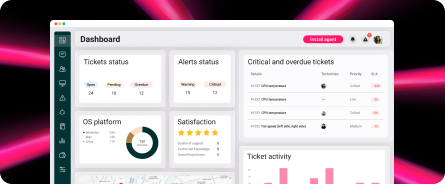
Below is a look at Atera’s admin dashboard:

Atera’s admin dashboard
For MSPs, creating new customer profiles with Atera is simple, and IT departments can get new users up and running quickly. If you need assistance during or after the process, Atera offers 24/7 live chat support.
Both Atera and Jamf have strong IT communities where users can troubleshoot problems and discuss them with other IT professionals in the field. Atera offers the additional bonus of access to an extensive knowledge base with different self-help materials to guide you.
Pricing plans and value for money
At Atera, we’re big advocates of transparent pricing plans. While enterprises can request a custom quotation, the pricing plans for IT departments range from $149 to $219 per month, and the MSP pricing plans range from $129 to $209 per month.
With Atera’s pricing plans, you can manage unlimited devices/endpoints for a fixed monthly cost. This differs from Jamf and most RMM pricing plans that charge pay-per-endpoint.
Atera’s pricing makes scaling predictable, and you can continue adding more endpoints without increasing your bottom line.

Atera’s pricing for IT departments
Here are our pricing plans laid out:
Atera pricing plans for IT departments:
- Professional: $149 per month, per technician
- Expert: $169 per month, per technician
- Master: $219 per month, per technician
- Enterprise: Custom quotation; contact sales to get pricing
- Pro: $129 per month, per technician
- Growth: $179 per month, per technician
- Power: $209 per month, per technician
- Superpower (Enterprise): Custom quotation. Contact sales for pricing.
Jamf, on the other hand, uses a pay-per-device structure. That means the price increases as more devices are added to the platform. This makes scaling less predictable and can lead to quickly inflating costs.
Another factor is how efficient the platform’s features make you. After all, this can lead to drastic cost savings.
With Atera’s Autopilot, you’ll be able to eliminate up to 40% of your IT workload and Copilot enables technicians to be 10x more efficient, which means your team can handle far more tickets and projects without adding headcount.
Customer reviews and ratings
Atera’s G2 Rating: 4.6 out of 5 stars (830+ reviews)
What Atera users are saying on G2:
- “Atera AI Copilot is amazing! It can help you solve an issue and also help create a knowledge base for the issue to reference in future problems, saving so much time,” a G2 user says.
- “The AI Assistant is constantly improving and has offered several helpful scripts. They constantly develop on the entire platform, with new features coming out frequently,” a G2 user says.
Atera’s Capterra Rating: 4.6 out of 5 stars (430+ reviews)
What Atera users are saying on Capterra:
- “Incorporating Atera’s AI assistant has brought about a delightful change in automating my operations. I have benefited from reduced wasted time on issues that could have taken me a lot of time to figure out by myself, while the AI comes up with a solution,” a Capterra user says.
- “The real-time monitoring feature has been very important in shifting from a reactive mode of managing IT to a proactive one,” a Capterra user says.
2. ManageEngine Mobile Device Manager Plus

ManageEngine Mobile Device Manager Plus is an MDM solution designed for IT organizations that need to manage and secure mobile devices, including smartphones, tablets, and laptops. Unlike Jamf, ManageEngine offers support for various operating systems, including Apple, Android, Windows, and Chrome.
Mobile Device Manager Plus is part of ManageEngine’s product group and can be integrated internally for more capabilities. For example, users can integrate it with ManageEngine RMM Central for remote monitoring and management capabilities. If paying multiple subscriptions isn’t a limiting factor, this may be a viable IT management option. – however, it may also be worth considering an all-in-one solution like Atera.
G2 Rating: 4.5 out of 5.0 stars (240+ reviews)
Capterra Rating: 4.6 out of 5.0 stars (760+ reviews)
ManageEngine Mobile Device Manager Plus Pricing:
- Free edition: Suitable for small-scale mobile device management
- Standard edition: Starts at $495 for 50 devices
- Professional edition: Starts at $895 for 50 devices
3. Kandji

Kandji is a suitable Jamf alternative for Mac and other Apple devices. It’s similar to Jamf in the sense that it’s generally used by mid-sized and enterprise businesses that need advanced automation capabilities and device and user policy compliance.
According to G2 users, Kandji’s biggest drawback is its inability to integrate and manage Windows devices. Kandji focuses entirely on Apple device management, which requires separate software solutions for non-Apple technology. One reviewer points out that this complicates device management workflow and increases costs.
G2 Rating: 4.7 out of 5.0 stars (500+ reviews)
Capterra Rating: 4.8 out of 5.0 stars (70+ reviews)
Kandji Pricing:
- iOS, iPadOS, tvOS: $1.60 per device, per month
- macOS: Starts at $3.20 per device, per month
- Enterprise: Based on a custom quotation
4. Addigy

Addigy is an IT management platform designed for managing Apple devices including Macs, iPads, iPhones, and Apple TVs. Some of its main features include automated device enrollment, configuration and application management, patch management, and security and compliance features.
Addigy also helps IT organizations maintain compliance with industry regulations, such as HIPAA, through continued monitoring and reporting. Like Jamf, Addigy provides integrations with Apple ecosystem products, such as Apple Business Manager, for automated enrollment and device management.
G2 Rating: 4.5 out of 5.0 stars (200+ reviews)
Capterra Rating: 4.6 out of 5.0 stars (10+ reviews)
Addigy Pricing:
- Standard: Up to $6 per Mac
- Premium: Up to $8 per Mac
5. LogMeIn Resolve

LogMeIn Resolve (previously GoTo Resolve) is an IT management solution for SMBs, IT departments, and MSPs. Some of its main features include RMM, MDM, IT asset management, help desk and ticketing, remote access, and IT automation features. The MDM feature set includes app installation and management, remote app administration, and real-time reporting on critical system updates.
The MDM features of LogMeIn Resolve are an add-on users must purchase in addition to the basic subscription. Depending on your budget, this could be considered a disadvantage.
G2 Rating: 4.4 out of 5.0 (430+ reviews)
Capterra Rating: 4.4 out of 5.0 (200+ reviews)
LogMeIn Resolve Pricing:
- Remote Access: $23/month
- Remote Support Plus: $44/month
- Standard: $57/month
- Premium: Custom pricing, contact sales
Mobile device management is an add-on for both LogMeIn Resolve’s Standard and Premium plans. It is not available for the Remote Access and Remote Support Plus plans.
6. Ivanti Neurons for MDM

Ivanti Neurons for MDM is an Ivanti product that helps IT departments manage devices for iOS, iPadOS, Android, macOS, ChromeOS, and Windows operating systems. It integrates with Google Zero-Touch enrollment, Windows AutoPilot, and Apple Business Manager for automated device enrollment.
To enhance the functionality of Ivanti Neurons for MDM, you can integrate it with other Ivanti products, such as Ivanti Neurons for UEM, to get endpoint management functionality. Ivanti is known for its robust capabilities. However, its costs add up quickly if you use several of its products.
G2 Rating: 4.2 out of 5.0 stars (70+ reviews)
Capterra Rating: 4.3 out of 5.0 stars (20+ reviews)
Ivanti Neurons for MDM Pricing:
- Custom pricing. To get the pricing, fill out your details on Ivanti’s website.
7. N-able N-central

N-able’s product, N-central, offers device management features for Apple devices. Similar to most Apple device management solutions, N-central enables automated device enrollment through Apple Business Manager integration. It also features patch management, RMM, automated scripting, endpoint security features, and more.
N-able creates multiple products for different purposes. This flexibility makes it attractive to users who don’t mind paying for multiple subscriptions.
G2 Rating: 4.4 out of 5.0 stars (450+ reviews)
Capterra Rating: 3.9 out of 5.0 stars (50+ reviews)
N-able N-central Pricing:
- Pricing is based on custom quotation. Visit their website to learn more.
8. Mosyle

Mosyle offers mobile device management for Apple devices, and it is aimed at IT departments and MSPs. Its key features include automated device enrollment, application management, patch management, and security and compliance. It also hosts a self-service portal for endpoint users to install approved applications and troubleshoot basic problems.
Mosyle does not support all operating systems. If you need to manage devices for Windows, ChromeOS, or Linux, you will need to explore other options.
G2 Rating: 4.6 out of 5.0 stars (45+ reviews)
Capterra Rating: 4.6 out of 5.0 stars (70+ reviews)
Mosyle Pricing:
- Mosyle Business Free: Free for up to 30 devices
- Mosyle Fuse: $3 per device/month for MacOS. $1.50 per device/month for iOS, iPadOS, and visionOS. A minimum of 30 licenses required.
- Mosyle Business Premium: $1 per device/month for Mac, iPhone, iPad, and visionPro. A minimum of 30 licenses required
9. NinjaOne

NinjaOne is a remote monitoring and management (RMM) solution for IT departments and MSPs. It offers mobile device management for Android and Apple devices, as well as other features like patch management, IT ticketing, reporting and analytics, and integrations with third-party software.
Similarly to Jamf, NinjaOne charges its customers based on pay-per-device/endpoint. The drawback of this is the high cost of managing many devices. A few other IT management solutions, including Atera, offer pay-per-technician pricing. Depending on a user’s needs, the pay-per-technician model may be more cost-effective.
G2 Rating: 4.7 out of 5.0 (1,400+ reviews)
Capterra Rating: 4.8 out of 5.0 (200+ reviews)
NinjaOne Pricing:
- Pricing is based on custom quotation. To learn more, visit their website.
10. Miradore

Miradore is an MDM solution that helps organizations manage, secure, and control their mobile devices across all operating systems. Miradore has many device security features, including the ability to enforce passcodes, lock and wipe lost devices, encrypt work data, and more.
Users can also control the use of devices across an organization and manage applications remotely. Miradore has numerous automation capabilities—such as its business policy feature—which enables quick enrollment and device configuration.
For capabilities such as RMM, remote access, and patch management, Miradore can be integrated with Atera. To begin a trial with Miradore, you simply need to contact Atera’s sales team.
G2 Rating: 4.6 out of 5.0 stars (120+ reviews)
Capterra Rating: 4.4 out of 5.0 stars (160+ reviews)
Miradore Pricing:
- Free: Free for basic mobile device management
- Premium: Starting from $50/month for 15 devices
- Premium+: Starting from $70/month for 15 devices
11. Microsoft Intune

Microsoft Intune provides users with a single platform for managing apps, mobile devices, and other virtual endpoints. Its main features include device and application management, remote access and configuration, policy enforcement, and security features for protecting company information.
One of Intune’s strengths is that it belongs to the Microsoft product family and integrates well with other Microsoft products, such as Microsoft 365, Configuration Manager, and Endpoint Analytics.
G2 Rating: 4.5 out of 5.0 stars (200+ reviews)
Capterra Rating: 4.6 out of 5.0 stars (35+ reviews)
Microsoft Intune Pricing:
- Microsoft Intune Plan 1: Starting at $8 per month per user for unified endpoint management
Agentic AI, all-in-one IT management: Only with Atera
In addition to providing device management capabilities for all OSs, Atera offers RMM, patch management, network discovery, and IT ticketing capabilities—all powered by AI through Atera’s two AI agents: Robin and AI Copilot.
Our AI agents pave a new path for managing an organization’s IT needs. For example, Atera’s AI ticketing system provides auto-ticket summaries, responses, suggestions, and an automated script generator. With AI-powered support, Tier-1 techs become Tier-2 techs, and senior techs have more time for strategic tasks.
Saved time translates into saved money. To improve on that equation, Atera allows IT teams to manage their organization’s needs with a single platform and a single subscription. This results in more savings while also providing the functionality most IT organizations require. If you’d like to try Atera for yourself, contact our sales team for a demo or try a 30-day free trial.
Now, let’s look at Jamf’s main strengths and limitations.
What is Jamf?

Jamf specializes in providing Apple device management solutions. One of its main products, Jamf Pro, is designed to help IT organizations manage and secure their Apple devices. IT professionals can use Jamf Pro to automate tasks such as deploying and maintaining software, managing device settings, and handling security incidents.
On the flip side, users report that integrations with Windows, Android, and Linux using Jamf are less seamless. The software is optimized for managing Apple and iOS devices, and users believe that the differences in performance when attempting to use Jamf with other operating systems speak for themselves.
Why look for a Jamf alternative?
After reviewing Jamf user reviews on platforms such as G2 and Capterra, we found its main limitations are:
1. No multi-OS support
2. An user interface with a steep learning curve
3) Inefficient customer support.
Here are more details on those drawbacks:
1. No multi-OS support
Jamf is an MDM software designed entirely for Apple devices, meaning it doesn’t offer support for Windows and Linux devices.
Many G2 users mentioned this and that they had to manage their Windows devices manually, since Jamf didn’t support it.
One G2 user specifically said, “Jamf is only compatible with Apple products, so no other OS platform can be managed. Other OS, such as Windows or Linux, will require an additional endpoint management tool.”
If your IT environment is multi-OS (which many are), this can be a notable deal breaker. Jamf’s focus on Apple has its benefits, but alternatives like Atera offer comparable device management capabilities across all major operating systems, including Apple, Linux, and Windows, making it a more flexible choice for diverse IT environments.
2. Steep learning curve
According to Capterra users, Jamf’s deployment process is laborious, making full utilization of Jamf Pro an overwhelming experience. This issue is particularly problematic for companies with limited resources.
Related to Jamf’s steep learning curve, one Capterra user mentioned:
- “Although generally satisfied with Jamf Pro, one drawback was the learning curve for some advanced features. Additionally, occasional updates caused minor disruptions in our workflow.”

Jamf Pro review via Capterra
Another Capterra user mentioned the following:
- “User experience is pretty dated at this point, which can be a bit of a barrier to usage outside of IT teams. Reporting capabilities could use some additional polish.”

Jamf Pro review via Capterra
3. Long customer support response times
Anyone working in the IT space knows the importance of customer support and educational resources. When issues arise, help should be available immediately.
Several G2 users mention that Jamf’s customer support varies depending on the complexity of the issue. One G2 user specifically said, “Customer support varies with the complexity of the situation. There are times when it seems to be dropped or left behind.”
In addition, another Reddit user mentioned that Jamf charges extra for their 24/7 customer support:

Jamf review via Reddit
If you’re new to device management, long wait times and extra costs for 24/7 customer support can be a dealbreaker.
At Atera, we always suggest considering IT management software options that provide robust customer service opportunities, including 24/7 live support as well as asynchronous resources like knowledge bases, live or on-demand webinars, and even online communities or forums to troubleshoot with other users. And guess what? Atera offers all of this and more.
What are Jamf’s strengths?
Jamf may have drawbacks, but it also has strengths. Let’s look at what customers appreciate about the product.
1. Reliable device management solution
Jamf users on G2 praise the software’s reliability for keeping Apple devices up-to-date with the latest software versions and OS patches. One G2 user specifically points out that Jamf allows dedicated admins to craft configurations, policies, settings, and accounts with minimum effort.
2. Integration with Apple Business Manager
Jamf integrates with Apple Business Manager, which many users appreciate. One G2 user mentioned that the integration helps their organization’s remote device enrollment go smoothly since new devices can be added immediately after purchase to the enrollment process.
Jamf pros and cons: Takeaways
After looking at Jamf’s customer reviews, we’ve laid out the main pros and cons of the platform below:
The pros:
- Reliable solution for managing and securing Apple devices
- Integrated with Apple Business Manager for easy device enrollment
The cons:
- Lack of multi-OS support due to Jamf’s 100% focus on Apple
- The user interface can feel overwhelming for new Jamf users
- Jamf’s customer support is sometimes reported to be slow to respond
- Limited AI-driven IT developments
- The pay-per-device model makes it challenging to grow and scale efficiently
Frequently Asked Questions
Related Articles
The 7 Best Patch My PC Alternatives in 2026
Discover the best Patch My PC alternatives. Compare them across pricing, features, AI, and user reviews. See which option works best for your organization.
Read now
The 7 Best Rev.io Alternatives Your IT Team Can Use In 2026
Learn about the best Rev.io alternatives that modern IT teams use. See how they compare across features, pricing, user reviews, and AI.
Read now
Top 7 Aisera Alternatives for 2026
Learn about the best Aisera alternatives. See how they differ across features, Agentic AI, pricing, and user reviews.
Read now
7 Best Autotask PSA Alternatives for 2026
Find out the best Datto Autotask PSA alternatives. See how they compare across features, pricing, user reviews, and Agentic AI.
Read nowEndless IT possibilities
Boost your productivity with Atera’s intuitive, centralized all-in-one platform